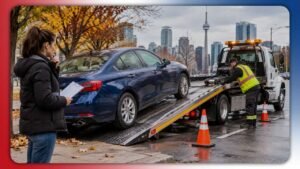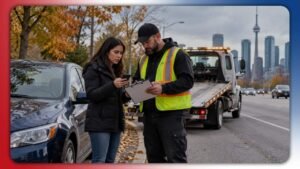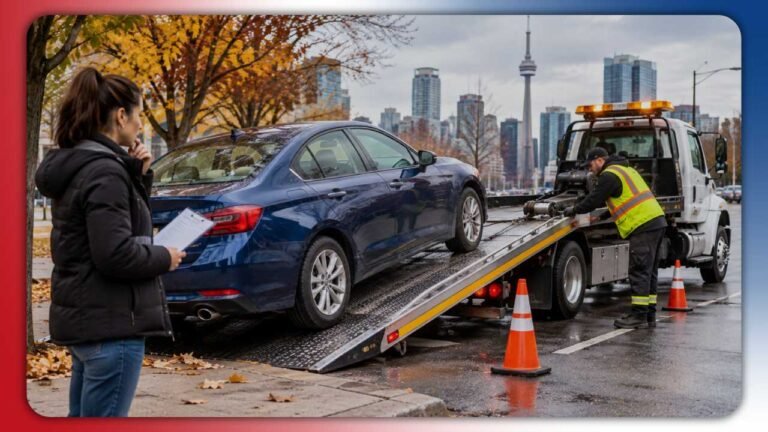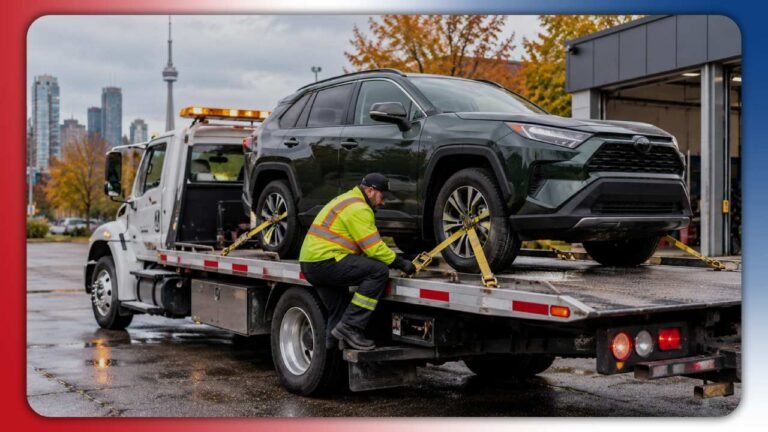

A vehicle can be towed from private property in Ontario when the removal follows lawful authority and applicable towing rules. Owning a driveway does not automatically give someone else permission to remove your properly parked vehicle.
You can face a lawful removal after an authorized parking enforcement process, an official order, or another recognized legal basis. The correct procedure depends on who owns the vehicle, who controls the land, and which municipality regulates parking.
Ontario regulates towing through the Towing and Storage Safety and Enforcement Act (TSSEA). The law generally requires documented consent to tow, with exceptions for certain authorized impounds and official directions. Review both provincial protections and local parking requirements.
Property ownership and vehicle ownership are separate legal questions. A landlord controls the property under applicable agreements. A vehicle owner retains statutory rights during the towing process. Neither party should assume that a verbal disagreement automatically permits immediate removal.
Vehicle owner consent and authorized enforcement
Ontario generally requires the prescribed person’s consent before ordinary towing begins. An authorized official can direct removal in specified circumstances without the vehicle owner’s permission.
For example, Toronto’s private-property towing bylaw establishes an enforcement path involving a penalty notice, a tow card, applicable waiting requirements, and signage. Do not confuse a building employee’s demand with the full municipal authorization process.
Ask the operator to identify the legal basis for towing. Record the officer’s name, incident number, tow card information, and time of dispatch. The required documents depend on the type of removal.
Private land ownership and vehicle ownership
You can own a detached home and legally park your registered vehicle in your driveway. Ordinary property disputes do not automatically authorize a towing contractor to remove your car.
An easement, tenancy agreement, court order, safety restriction, or municipal violation can change the analysis. Obtain the relevant document before deciding whether a removal was proper.
A driveway crossing the municipal sidewalk also affects public access. A vehicle protruding into the sidewalk or road allowance can trigger parking enforcement even when part of the vehicle remains on private land.
Towed From Private Property Ontario: Your Own Driveway
Your own driveway generally offers stronger control over parking than a shared condominium lot. A stranger cannot normally order your vehicle removed simply because the stranger dislikes your parking.
You should separate 3 situations: your car sits fully on your own driveway, someone blocks the driveway entrance, or an unauthorized car occupies your driveway. Each situation calls for different evidence and enforcement channels.
Photograph the property boundary, parked vehicle, licence plate, street signs, and driveway entrance. Preserve photographs before another person moves the vehicle or a municipal officer arrives.
Cars you own on your driveway
Check property records and relevant restrictions before contesting a tow. The title, subdivision rules, lease, and municipality’s parking bylaws affect your rights.
A vehicle stored on private land can attract separate concerns about derelict vehicles, zoning, or unsafe conditions. Municipal enforcement typically follows the applicable notice-and-order procedure rather than an arbitrary private pickup.
Contact the municipality when an officer cites a parking or property standards violation. Ask for the precise bylaw, written notice, appeal procedure, and enforcement deadline.
Unknown vehicles blocking your driveway
Call your municipal parking enforcement service when a vehicle blocks access from the street. Share the license plate, exact address, and photographs showing the obstruction.
An unknown car fully inside your driveway presents a different enforcement question. Ask municipal staff or police which authority can authorize removal at your address. Do not privately tow the car without checking local requirements.
Never enter, push, unlock, or damage another person’s car. A private tow arrangement without appropriate authority can create additional liability and delay the vehicle’s lawful release.
Towed From Private Property Ontario: Condo and Apartment Parking
Condominium parking rights depend on the declaration, parking allocation, posted rules, and applicable enforcement law. A numbered parking space does not automatically let you tow any vehicle using the space on your own.
Owners sometimes hold title to a space, while tenants or residents receive permission to use designated stalls. The condominium corporation or property manager generally coordinates parking enforcement under building rules.
Read the condo declaration, rules, lease, and any parking authorization. Confirm which party can request an enforcement officer and which procedure applies in the municipality.
Assigned spaces and visitor stalls
Keep a photograph of your assigned stall number and valid parking permit. Ask management to identify the rule behind any ticket or removal.
Visitor stalls often impose registration limits, time restrictions, or overnight parking conditions. Record the posted requirements, booking confirmation, and any electronic visitor permit.
Parking arrangements can change after a board decision or policy notice. Request a dated copy of the current rule rather than relying on an older hallway poster.
Parking notices and building management
Report a wrongly parked vehicle to the property manager or security desk. Supply the license plate, photographs, stall number, and time of discovery.
Ask whether management registered the parking location for municipal enforcement. A contractor’s private patrol alone does not establish the legal authority to impound a vehicle.
Consult the Ontario towing rights guide when a dispute concerns consent, vehicle access, or an invoice. Save the incident number and written communications with building management.
Toronto Private Property Towing Authorization
Toronto regulates non-consensual private-property removal through Municipal Code Chapter 915. The city requires prescribed enforcement steps rather than unrestricted private towing.
For non-consensual removal under the Toronto bylaw, a penalty notice and a Toronto Police Service tow card form part of the required process. Applicable signs and waiting periods also matter.
Chapter 915 sets the standard waiting period at 30 minutes, subject to specified exceptions. Confirm the exact current provisions for your circumstances before assuming a waiting period applies.
Parking penalties and police tow cards
Ask the enforcement officer whether the vehicle received a penalty notice. Obtain the ticket number, issue time, and authorization details.
Toronto’s tow-card process connects municipal parking enforcement with removal. A property manager should not present an informal paper slip as proof of the official tow-card requirement.
If your vehicle disappears, contact Toronto Police parking enforcement or the relevant police service. Provide the registration and licence plate before assuming theft.
Signage and local waiting periods
Check the entrance for parking restriction signs, tow warnings, posted hours, and permit terms. Photograph every sign from the driver’s approach and parking location.
Toronto requires signage under applicable private-property towing provisions. The exact requirements and exceptions depend on the parking offence and relevant bylaw.
A signed fire route can follow different enforcement rules from an ordinary visitor stall. Ask the officer which exemption applies and record the bylaw reference.
Ontario Municipal Differences That Affect Removal
Ontario’s provincial towing legislation establishes consumer protections, while municipalities regulate many parking enforcement processes. Toronto and Oakville do not use identical private-property towing procedures.
Before you arrange a non-consent tow, identify the municipality and review that municipality’s current parking enforcement guidance. Do not use a Toronto tow-card checklist for an Oakville property.
Private lots in Mississauga, Brampton, Vaughan, and Markham can face different municipal rules. Call local parking enforcement before booking a contractor.
Oakville parking enforcement
Oakville By-law 2024-187 regulates vehicle towing without the owner’s consent. The town states that designated enforcement officers or police authorize those removals.
Oakville generally requires a penalty notice and a 30-minute wait, subject to defined exceptions. The town also outlines permanent sign requirements for regulated parking properties.
The town exempts private dwelling driveways from its signage requirement. That exception does not remove the need for lawful authority to tow.
Other GTA municipalities
Contact the appropriate municipality to enforce commercial lots, apartments, or private residential properties. Describe the exact parking location rather than only the postal address.
Ask 3 questions: who can authorize the tow, whether a parking penalty is required, and whether the officer must attend first. Request the applicable bylaw link.
Keep the municipal response for your records. You can show the response to a property manager, building security, or certified tow operator before any removal.
How to Handle an Unauthorized Vehicle on Your Driveway
To handle an unauthorized vehicle on your driveway, document the obstruction, contact local enforcement, and obtain lawful authorization before booking towing.
First, photograph the complete vehicle, licence plate, driveway boundaries, nearby signs, and blocked access. Record when you first observed the car and any contact attempts.
Second, call municipal parking enforcement. Explain whether the vehicle blocks your driveway entrance or occupies private land. Ask whether a police officer or municipal officer must authorize removal.
Third, follow the official instruction. Contact a certified operator only after confirming authorization. Do not assume that a signed contract with a tow company replaces required municipal approval.
Fourth, request an itemized quote and, when appropriate, a documented destination. Avoid telling the driver the vehicle belongs to you when you do not own it.
Fifth, store the evidence, officer details, towing paperwork, and photos. Records support later questions about damage, release, parking enforcement, or disputed charges.
| Task | Timing | Method | Difficulty |
| Record evidence | Immediately | Photos, plate, time, boundary | Easy |
| Confirm authority | Before dispatch | Municipal enforcement or police | Moderate |
| Verify tow company | Before removal | Certificate, quote, legal basis | Moderate |
| Find towed vehicle | Immediately after discovery | Police or parking enforcement | Moderate |
| Arrange release | As soon as available | Yard, ID, invoice, payment | Moderate |
How to Recover a Vehicle After Private Property Towing
To recover a vehicle after private property towing, confirm the vehicle’s location, obtain an itemized bill, and arrange release promptly.
Call the relevant police non-emergency line or municipal parking enforcement if you suspect an impound. Share the licence plate, vehicle identification number, and your last known parking address.
Contact the storage facility once you learn the location. Ask for business hours, identity requirements, payment methods, current total, and any official hold affecting release.
Bring your photo identification, registration, proof of authority to collect the car, and payment method. A rental vehicle can require additional approval from the registered owner.
Ask the yard for written fee details before paying. Take photographs of the vehicle on collection, and note any changes in condition immediately.
Read the vehicle storage fee guidance for information about storage billing, release arrangements, and avoiding unnecessary additional days. Arrange transport before the next storage billing period whenever practical.
Towing Charges and Storage Costs in Ontario
Ontario does not apply one universal price to every private-property towing job. Your lawful charge depends on the operator’s filed rate schedule and any applicable municipal fee rules.
GTA Towing & Scrap Cars publishes a general local towing range of $100–$250 in its Toronto price guide. That published estimate describes ordinary local service, not a guaranteed non-consent impound charge.
The company also describes local hook-up fees of $75–$150 and distance charges of $3–$7 per kilometre (about $4.83–$11.27 per mile). Verify the quote for your exact service before authorizing work.
Toronto Police publishes separate contract towing and storage rates for police-authorized work. Those listed amounts belong to the relevant contracts and categories, not automatically to every private contractor.
Toronto’s Chapter 915 also ties certain private-property towing charges for vehicles at or below 6,000 kilograms (13,228 pounds) to applicable police contract rates. Confirm the relevant category with enforcement.
Ontario requires certified operators to disclose maximum rates and issue invoices. You can negotiate below a published maximum, but an operator cannot lawfully charge more than the applicable filed maximum.
The Toronto towing cost guide explains ordinary tow-distance estimates. Compare published ranges while separating police-authorized towing from voluntary roadside assistance.
Rights and Complaints After an Improper Tow
You can challenge an improper tow by collecting evidence and reporting concerns to the appropriate authority. Start with the towing consent and lawful authorization basis.
Ontario requires tow operators and vehicle storage businesses to follow certification and consumer-protection rules. The provincial guidance covers rates, invoices, consent, vehicle access, and complaints.
Ask for the tow operator’s legal name, certificate number, vehicle destination, and itemized invoice. Record all conversations, payment receipts, parking signs, and property manager instructions.
Use the Ontario towing complaint process for suspected breaches of provincial operator rules. Municipal parking ticket reviews and police complaint processes follow different routes.
Dispute a parking penalty through the municipality’s stated process rather than arguing with the yard attendant. A storage operator usually cannot cancel a municipal parking ticket.
If someone damaged your vehicle, photograph the damage before driving away. Preserve pre-tow photos and seek legal advice when liability or insurance coverage remains disputed.
Practical Examples for Driveways, Condos and Plazas
Consider a homeowner who finds an unknown sedan fully inside a private driveway in Scarborough. The homeowner should document the vehicle and request Toronto enforcement guidance before arranging removal.
Now consider a condo resident in North York who discovers a visitor parked in a numbered stall. The resident should contact management and provide the parking allocation and permit evidence.
A plaza manager in Etobicoke sees a vehicle parked beyond the posted visitor limit. The manager must still follow applicable municipal requirements before arranging a non-consent tow.
A tenant in Oakville discovers a car across a private dwelling driveway. The tenant should contact Oakville enforcement and verify applicable driveway exceptions and authorization requirements.
A driver returns to an empty parking space after receiving a municipal penalty. The driver should locate the vehicle through the proper authority, check the tow paperwork, and arrange prompt release.
A car owner discovers an invoice higher than the operator’s published maximum. The owner should preserve the invoice and rate schedule, then use Ontario’s complaint process.
The correct first action is evidence collection, not self-help removal. Written documentation protects both property occupants and vehicle owners during a private parking dispute.
Frequently Asked Questions
Can someone tow my car from my own driveway in Ontario?
Generally, no, without lawful authority. An official enforcement order, applicable bylaw, or another legal basis can change the result.
Can I tow a stranger’s car parked on my driveway?
Not automatically. Contact local parking enforcement to confirm who can authorize removal and which procedure applies.
Can a condo board tow a car from an assigned space?
Yes, where lawful authorization and local requirements permit removal. A condo rule alone does not replace applicable enforcement steps.
Does Toronto require a ticket before towing from private property?
Generally, yes, for the non-consent process under Chapter 915. Specific exceptions and tow-card requirements apply.
Can I dispute private property towing fees in Ontario?
Yes. Request an itemized invoice, compare the applicable maximum rates, and file a provincial complaint when appropriate.
Private Property Towing Decisions and Next Steps
Private-property towing depends on lawful authorization, municipal procedures, and Ontario’s towing protections. Check the property type and enforcement authority before anyone removes a vehicle.
You can protect your position by saving photos, recording the parking rules, reviewing rate schedules, and requesting written proof of authorization. For guidance on local towing services, review our Toronto towing cost guide and contact GTA Towing & Scrap Cars for a service-specific quote.