
AWD towing 4WD towing normally requires a flatbed or approved dollies that keep all four wheels off the road. Regular two-wheel-drive towing often leaves one axle rolling, which risks damaging a connected AWD or 4WD drivetrain. Your exact manufacturer instructions decide the safe approach.
Across Toronto, Mississauga, Brampton, Vaughan, and Scarborough, breakdown crews encounter crossovers, pickups, and SUVs with different drive systems. A Subaru Outback, Toyota RAV4 AWD, and Jeep Wrangler 4×4 do not share identical towing instructions. You should identify the exact model and drivetrain before a truck arrives.
AWD Towing 4WD Towing Requires Different Equipment
The main difference is wheel contact. A flatbed carries the whole vehicle above the pavement. A standard wheel-lift truck raises 2 wheels while the remaining 2 rotate. The second method suits selected two-wheel-drive vehicles, not most AWD breakdowns.
The tow operator must account for the driveline, transmission position, parking brake, damaged steering, and vehicle weight. Your request for a standard tow gives dispatch too little information. State AWD or 4WD and the model year so dispatch selects compatible recovery equipment.
AWD Couplings and Rotating Axles
All-wheel drive (AWD) transfers engine torque to both axles continuously or when traction changes. Systems vary across Subaru Symmetrical AWD, Audi quattro, and Toyota electronic AWD designs. A rotating axle during towing can turn connected drivetrain components without normal operating conditions.
Towing one axle on the road can create speed differences inside centre couplings and differentials. Mazda Canada instructs drivers to keep all wheels raised during towing for its AWD models. Your owner manual should always settle exceptions.
4WD Transfer Cases and Drive Modes
Four-wheel drive (4WD) often uses a selectable transfer case. Jeep Wrangler models illustrate systems with specific transfer-case procedures. Other 4WD vehicles prohibit wheels-down transport despite having a dashboard neutral setting. Do not assume every 4WD truck behaves alike.
The transmission neutral position and transfer-case neutral are different controls. A transmission in neutral does not necessarily disconnect every shaft. Manufacturer-approved recreational towing procedures also differ from a breakdown tow involving seized brakes or damaged suspension.
AWD and 4WD Drivetrains Create Different Towing Risks
Improper towing can damage the transfer case, transmission, differential, or AWD coupling. Component risk depends on the exact mechanical design. Your vehicle might also suffer tire, bumper, or suspension damage during an incorrect recovery.
Rotating grounded wheels can drive shafts while the engine remains stopped. Some gearboxes rely on pumps or lubrication patterns unavailable during towing. Drivers should never interpret a free-rolling wheel as proof of drivetrain safety.
Heat and Lubrication Problems
A gearbox or transfer case can experience friction when components rotate without normal lubrication. Heat buildup depends on speed, distance, and system design. Even a short tow deserves the correct method because a safe distance cannot be assumed across vehicle models.
Owners should avoid accepting an unsupported promise that 1 mile (1.6 km) cannot hurt an AWD drivetrain. Ask the operator to check the manufacturer towing procedure instead. Photographs of the loading method also help document the pickup.
Transmission, Coupling, and Differential Damage
Connected drivetrains contain moving parts such as axles, driveshafts, clutches, and differentials. Incorrect rotation can stress assemblies beyond their intended use. Warning lights or new vibration after transport deserve prompt inspection from a qualified technician.
Record the vehicle condition before handover. Photograph dashboard warnings, wheel positions, the tow equipment, and the pickup location. Keep the tow invoice and dispatch confirmation if a new drivetrain problem appears.
Flatbed Transport Protects Connected Drive Wheels
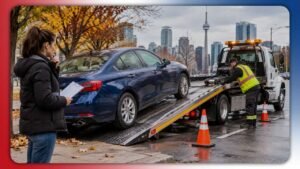
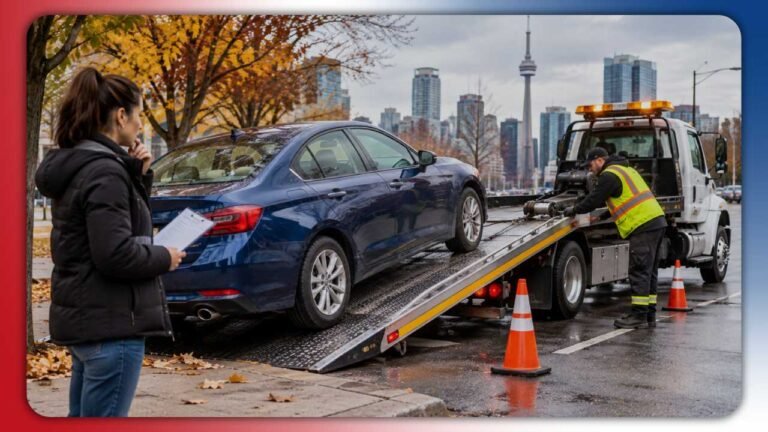
Flatbed towing is the preferred transport method for most disabled AWD and 4WD vehicles. A hydraulic deck carries all 4 wheels. Professional operators secure the vehicle at approved points and stop wheel rotation during the journey.
The operator checks payload capacity, loading angle, clearance, and attachment locations before moving. A low vehicle needs a gentle approach. A vehicle with collision damage needs an inspection for dragging parts and unstable wheel assemblies.
Loading an AWD SUV onto a Flatbed
The crew positions the carrier, secures the work area, and checks the manufacturer recovery points. Next, the operator moves the vehicle onto the deck using an approved winch arrangement. Wheel straps or approved restraints hold the vehicle for transport.
The operator also checks steering position and the parking brake procedure. Never attach a winch hook to a bumper or suspension arm without manufacturer approval. Tow eyes and structural recovery points serve different loads across models.
Flatbed Space and Clearance Requirements
A full-size flatbed needs room behind the stopped vehicle to lower its ramp. Parking garages, narrow laneways, and steep driveways can restrict access. Tell dispatch your ceiling clearance in feet and metres, such as 7 feet (2.1 m).
For a driveway, photograph the access path and identify parked obstacles. A tow operator can evaluate alternate positioning or a smaller recovery vehicle. Do not attempt to push an immobile AWD vehicle into moving traffic.
Wheel-Lift and Dolly Towing Has Specific Conditions
An approved wheel-lift with dollies can keep all 4 wheels off the ground. Some manufacturer manuals permit that arrangement. Ordinary wheel-lift towing with 2 tires rolling remains unsuitable for many AWD models.
A dolly supports the axle that a wheel-lift truck would otherwise leave rolling. The combined arrangement requires compatible equipment, tire restraints, load limits, and enough road clearance. Operators must confirm the owner manual allows the method.
Approved Dollies for Restricted Access
Underground garages sometimes prevent full-sized carriers from reaching the vehicle. Specialized wheel-lift trucks and dollies offer an alternative when the manufacturer approves the loading method. Dispatch needs the garage level, ramp slope, and ceiling height.
Request a description of how every wheel will remain off the road. If the operator cannot explain the method, stop the hookup. A short distance through a parking structure still requires appropriate handling.
Recreational Flat Towing Exceptions
Some 4WD models permit recreational towing behind a motorhome after a detailed transfer-case procedure. The instruction applies only to specified drivetrains and configurations. A disabled vehicle with transmission damage might not satisfy those conditions.
Read the model-year manual before treating an RV towing exception as emergency guidance. Never generalize one Jeep, Ford, or Chevrolet procedure to another model. The safest commercial recovery option usually remains a flatbed.
How to Arrange AWD Towing 4WD Towing in the GTA
To arrange AWD towing 4WD towing in the GTA, tell dispatch your exact vehicle details and request all-wheels-off-ground transport. Share your pickup address, destination, wheel condition, and access restrictions. Confirm the method before authorizing the tow.
Compare the differences in the company’s flatbed versus wheel lift guide before requesting a vehicle recovery.
Vehicle Details to Give the Dispatcher
Provide the year, brand, model, trim, and drivetrain. Identify symptoms such as locked steering, a failed transmission, or collision damage. Give the destination address and say whether the vehicle sits underground, in a snowbank, or on a highway shoulder.
For example, a 2022 Toyota RAV4 AWD with a locked rear wheel needs different preparation than a rolling 2018 Jeep Wrangler. A clear description helps prevent dispatching unsuitable equipment and repeat service visits.
Confirming the Arrival and Tow Authorization
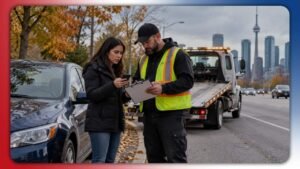
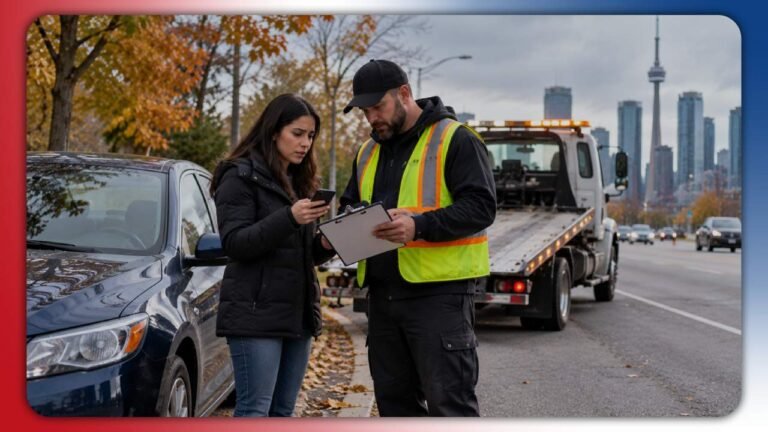
Ask for the business name, operator identification, estimated arrival window, loading method, and written price information. Inspect the equipment before signing. Ontario towing rules provide consumer protections, including consent requirements and a published maximum-rate framework.
Discuss pickup details with dispatch before choosing a towing method. Confirm your access restrictions and the correct carrier.
Vehicle Preparation Before Flatbed Loading
Prepare by securing people first, then documenting the vehicle. Move passengers away from passing traffic. Call emergency services for injuries, fire, or immediate danger. Leave mechanical recovery to trained operators.
Take pictures of all 4 tires, body panels, the dashboard, and existing damage. Remove valuables when safe. Give the operator keys or approved electronic access instructions while protecting personal information.
Neutral, Parking Brake, and Electronic Controls
Follow the owner manual for transport mode, neutral selection, and electric parking brake release. Electronic shift controls on some vehicles need battery power. A disconnected battery can prevent ordinary disengagement procedures.
Do not crawl beneath the vehicle or force the transmission selector. Warn dispatch about a dead 12-volt battery, frozen parking brake, or immobilized wheels. Operators can arrange skates or suitable lifting gear where appropriate.
Tie-Down Checks Before Departure
The operator should choose approved tire or vehicle restraints and check load security. Look for safe clearances around brake hoses, bumpers, and suspension parts. Ask the operator to document existing damage before loading.
A vehicle that shifts or rolls on a deck needs immediate correction before travel. Do not demand that the tow operator release the restraints for a photograph. Take safe exterior pictures without entering the active loading zone.
Common Mistakes That Cause Drivetrain Damage
The biggest mistake is letting 2 wheels roll without manufacturer approval. Other errors include assuming neutral solves every towing restriction and ignoring electronic parking brakes. You can prevent avoidable damage by confirming the exact tow method beforehand.
A driver might describe an SUV as front-wheel drive even when its trim includes AWD. Check the rear badge, registration documents, vehicle identification information, or owner manual. Vehicle branding alone does not prove the drivetrain configuration.
Incorrect Wheel-Lift Hookup
A lift that raises only the front axle leaves the rear tires rotating. For many AWD vehicles, that movement risks turning interconnected components. Stop the hookup and request a flatbed or manufacturer-approved all-wheels-up arrangement.
Do not rely on the driver’s claim that the tow is short. Explain the manufacturer restrictions and ask dispatch for compatible equipment. A safe tow begins with the right truck, not a faster departure.
Unapproved Recovery Points
A hook attached to a control arm, bumper cover, or exposed drivetrain component can damage the vehicle. Recovery hardware needs the manufacturer-designated attachment point. Report missing tow-eye hardware before loading begins.
Collision-damaged cars need extra care around bent wheels and leaking fluids. A technician should assess immediate hazards before the operator applies pulling force. Vehicle condition determines whether skates, cribbing, or special loading tools are necessary.
GTA Towing Prices and Ontario Consumer Protections
GTA Towing & Scrap Cars publishes an illustrative CAD $200–$350 range for an AWD or electric tow under 15 km (9.3 miles). The website presents that range as an example, not a guaranteed quotation. Your vehicle, location, and recovery conditions affect the final estimate.
Check the published examples in the Toronto towing cost guide. Ask the dispatcher for the applicable service rate and a written quote before authorizing transport.
The same website discusses an indicative CAD $25–$75 extra charge for flatbed versus wheel-lift service. Treat those amounts as published examples, not fixed company commitments. Never infer a final invoice from a general article alone.
Ontario Consent and Rate Transparency
Ontario regulates commercial towing under the Towing and Storage Safety and Enforcement Act (TSSEA). Drivers should inspect required consent and rate information before a voluntary tow. Special rules apply to police-directed recoveries and restricted highway towing zones.
Ask the operator to explain the destination, charges, storage arrangements, and paperwork. Keep copies of all signed documents. Contact the appropriate provincial regulator if you suspect an unauthorized charge or improper towing practice.
Insurance and Drivetrain Damage Records
Ask your insurer about towing benefits and any limits under your individual policy. Coverage depends on endorsements, accident details, and claim conditions. A tow operator cannot guarantee reimbursement on your insurer’s behalf.
Save the booking record, condition photos, invoice, mechanic diagnosis, and repair estimate. Those records support a clear timeline if you dispute damage after towing. Report concerns promptly and avoid approving unnecessary work before discussing coverage.
Recovery Choices for Winter, Crashes, and Garages
The best recovery method depends on vehicle access and mechanical condition. A snowy shoulder, collision scene, and underground garage create different hazards. All 3 settings still require drivetrain-safe handling and appropriate authorization.
Winter recovery requires safe traction and a clear loading path. Collision recovery requires assessment of fluid leaks and wheel damage. Garage recovery requires checking ramp slopes and overhead clearance before sending equipment.
Snowbanks and Highway Shoulders
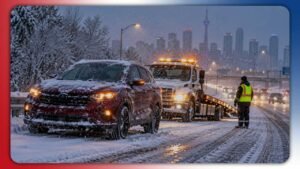
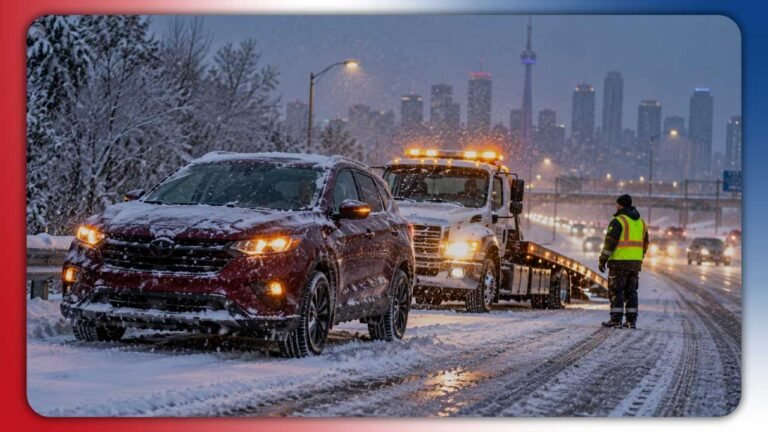
Keep occupants away from traffic and tell dispatch about ice, blocked lanes, and visibility. Some provincial highways have restricted towing zones with authorized providers. Follow the official roadside instructions for your exact location.
Do not let an unauthorized operator begin pulling the vehicle. A stuck AWD SUV might require winching before flatbed loading. The operator must consider ground conditions and approved recovery points.
Underground Garages and Collision Damage
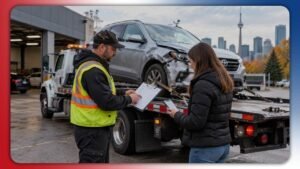
Give the garage clearance, parking level, and gate access details. For collisions, mention bent suspension, deployed airbags, and fluid leakage. The operator can plan a suitable extraction instead of attempting an unsafe standard hookup.
In crowded GTA locations, safe pedestrian control matters as much as vehicle clearance. Keep onlookers away from cables and moving equipment. Take photographs from a protected location only.
AWD and 4WD Towing Quick-Reference Table
Use the following comparison before calling. Timings describe when to act, not guaranteed arrival or loading durations.
| Task | Timing | Method | Difficulty |
| Confirm drivetrain | Before dispatch | Manual and vehicle details | Easy |
| Select flatbed | Before booking | All wheels supported | Easy |
| Assess locked wheels | Before loading | Skates or approved equipment | Moderate |
| Check garage clearance | Before arrival | Measure height and access | Moderate |
| Record vehicle condition | Before hookup | Photos and documents | Easy |
| Confirm tow charges | Before consent | Written estimate | Easy |
AWD and 4WD Towing FAQs
Can an AWD vehicle be towed with 2 wheels on the ground?
No, not for most models. Use a flatbed or a manufacturer-approved combination that lifts every wheel.
Does putting a 4WD vehicle in neutral make towing safe?
No. Transmission neutral alone does not confirm the transfer case or drivetrain permits wheels-down transport.
Is a flatbed always required for 4WD towing?
No. Some manufacturer-approved dollies or recreational procedures exist. Check the exact model-year instructions.
Can towing an AWD vehicle incorrectly damage the transmission?
Yes. Incorrect wheel rotation can stress the transmission, differentials, coupling, or transfer case.
Does AWD towing cost more in Toronto?
Sometimes. Special equipment and recovery needs affect costs. Request an itemized quote before approving service.
Book the Right Tow for Your AWD or 4WD Vehicle
Protect your drivetrain by requesting a manufacturer-compatible, all-wheels-off-ground tow. Verify your model, pickup location, and written estimate before approving work.
Contact GTA Towing & Scrap Cars through its local GTA towing services page to request appropriate recovery equipment across Toronto and the surrounding GTA.