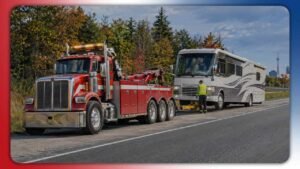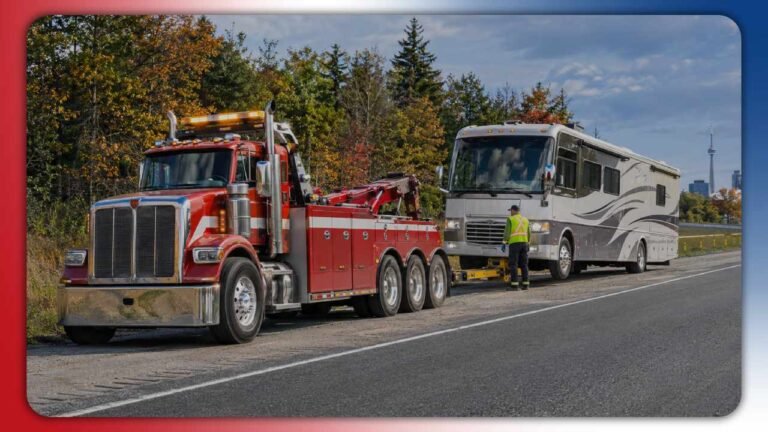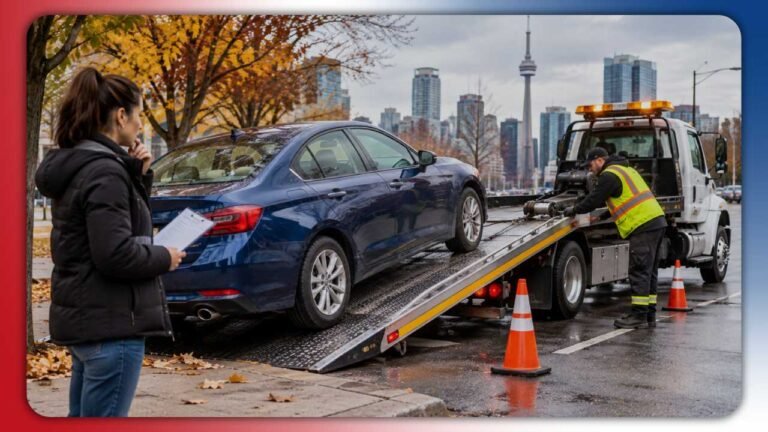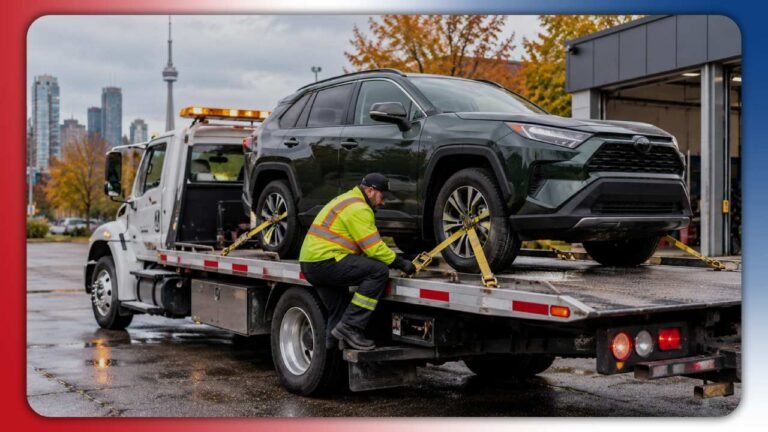

Semi truck towing Toronto requires a heavy-duty recovery assessment, suitable towing equipment, safe vehicle connections, and a planned delivery route. Dispatchers also check trailer load, axle condition, road hazards, and Ontario towing requirements before moving the truck.
A disabled tractor-trailer can block a loading bay, shoulder, or highway lane. You need accurate dispatch information before any crew selects a heavy wrecker. Toronto traffic, tight industrial entrances, and loaded trailers increase planning demands. The goal is safe removal without extra damage to the tractor, trailer, freight, or roadway.
Semi Truck Towing Toronto and the Work Behind Each Tow
Heavy-duty towing moves a disabled large vehicle; recovery first frees a trapped, overturned, or inaccessible vehicle. A normal tow starts with a stable truck on a suitable surface. A recovery call needs extra assessment and often more machinery. Your dispatcher must distinguish those jobs before assigning a unit.
A tractor without a trailer creates different loading and balance demands than a tractor pulling a loaded semitrailer. Brake damage, steering damage, blocked wheels, and road position also change the towing plan. Your operator must assess actual vehicle condition, not just vehicle size.
Commercial Vehicles That Need Heavy-Duty Towing
Common assignments include highway tractors, straight trucks, dump trucks, refrigerated trucks, buses, and delivery vehicles. Each vehicle carries different frame geometry, axle arrangements, and towing attachment points. A box truck with damaged steering needs another plan than a road tractor with a failed engine.
Gross vehicle weight rating (GVWR) identifies the manufacturer’s maximum rated loaded weight. Dispatchers also need actual trailer and cargo weight when available. An empty trailer and a fully loaded trailer do not place identical demands on recovery equipment.
The Difference Between Towing and Accident Recovery
A controlled tow generally starts after a crew confirms stable wheels and accessible recovery points. Collision recovery can involve spilled cargo, damaged axles, leaking fluids, or a vehicle resting off-road. Operators assess the scene before using winches, cranes, or stabilization equipment.
A driver should never direct an unqualified person to pull a heavy vehicle using a pickup truck. Incorrect attachment points can damage a chassis and create serious injury risks. Call emergency services for injuries, fire, or immediate roadway danger.
Equipment Used for Semi Truck Towing Toronto
A heavy-duty wrecker usually handles a suitable disabled tractor, while special recovery equipment handles complex scenes. Capacity, vehicle configuration, and load condition determine the equipment choice. A visible large tow truck does not prove capacity for every tractor-trailer combination.
Heavy Wreckers, Underlifts and Rotators
An underlift supports an approved axle or towing point while the wrecker moves the vehicle. Operators check clearance, front-end loading, and axle protection before lifting. A rotator provides controlled lifting and positioning at difficult recovery scenes. A winch pulls equipment only within an engineered recovery plan.
Some commercial loads require a second tractor, trailer transfer, or equipment transporter. Heavy machinery such as excavators or forklifts can need a dedicated transport trailer rather than ordinary towing. Ask the dispatcher whether the provider has suitable capacity or must arrange a specialist.
Air Brakes, Drivelines and Trailer Connections
Heavy-truck air brakes, driveshafts, differential systems, and fifth wheel couplings require trained inspection. The towing crew follows vehicle-specific procedures to prevent driveline damage and uncontrolled movement. Never loosen brake equipment or disconnect shafts without proper training.
For a trailer connection, the crew verifies kingpin engagement, electrical lines, air connections, landing gear, and wheel chocks. The team checks axle and tire condition before movement. Trailer brake status can change whether the operator separates the tractor and trailer.
The Complete Commercial Truck Towing Process
A normal job follows 4 stages: dispatch, scene assessment, hookup, and delivery. Recovery incidents add stabilization, lifting, or cargo work. You can reduce delay by sharing precise vehicle information during the first call.
Dispatch Assessment and Roadside Protection
Dispatch asks for truck type, trailer status, cargo description, roadside position, and a reliable pickup location. A Highway 401 exit number or nearby service center gives a better location than a broad neighborhood. Share the direction of travel and nearest interchange.
On arrival, the crew checks hazards, access space, wheel condition, and required traffic protection. Emergency responders or authorized roadway personnel control unsafe incident scenes when necessary. A towing operator then chooses approved rigging and vehicle movement methods.
Hookup, Securement and Delivery
The operator identifies approved lifting points, checks clearances, and protects vulnerable vehicle components. The crew completes a pre-move inspection and confirms that tires, brakes, and connections suit the planned tow. The team selects an accessible repair shop, storage yard, or fleet terminal.
Tell dispatch if your destination has a gate, narrow turning radius, or loading dock. A tractor-trailer combination needs more turning space than a passenger car. Ask your receiving site to confirm arrival access before the tow begins.
Quick-reference table: typical workflow tasks, planning windows, methods, and difficulty. Timing depends on traffic, access, damage, staffing, and equipment availability; the figures show planning ranges, not service guarantees.
| Task | Planning time | Method | Difficulty |
| Dispatch fact check | 5–15 minutes | Confirm truck, load, site and destination | Moderate |
| Scene safety assessment | 10–30 minutes | Inspect road, vehicle and approach | High |
| Standard heavy-duty hookup | 20–60 minutes | Approved lift and securing procedure | High |
| Complex recovery | Variable; often hours | Specialized stabilization or lifting | Very high |
| Delivery and handoff | Distance-dependent | Controlled tow and receiving-site inspection | Moderate |
Safety Steps for Drivers on GTA Roads
Protect people first, share your location second, and arrange recovery only when the scene is safe. Stop operating a truck with serious brake, steering, tire, or coupling damage. Follow police or highway responder directions at a collision scene.
Breakdowns on Highway 401 and Major Routes
Switch on hazard lights and stop in the safest available location. Move behind a protective barrier when you can reach one safely. Avoid standing between moving traffic and your tractor. Call 911 when injuries, fire, dangerous cargo, or immediate traffic hazards demand emergency assistance.
Provide the highway direction, exit number, lane position, and tractor identification. A 53-foot (16.2 m) trailer needs more room than a small van. A narrow shoulder limits access for cranes and heavy wreckers.
Loaded Trailers, Dangerous Goods and Collision Scenes
Report cargo weight, trailer type, and load shift concerns before a truck arrives. Refrigerated loads need temperature planning during a prolonged breakdown. Tankers and hazardous-material loads need specialized response procedures and proper incident coordination.
Leave damaged cargo restraint systems untouched until qualified personnel assess the risk. Photograph visible damage from a safe place when permitted. Keep the bill of lading and fleet contact available for authorized recovery decisions.
Semi Truck Towing Costs and Ontario Rate Rules
Semi-truck pricing depends on the operator’s published maximum schedule, actual service, distance, and recovery complexity. GTA Towing & Scrap Cars publishes $100–$250 for standard local towing. That passenger-vehicle figure does not establish a rate for a semi truck.
For general pricing background, read the Toronto towing price guide. Ask for a truck-specific written estimate and the applicable maximum rate schedule. Confirm whether the job needs one wrecker, 2 vehicles, specialized equipment, or separate trailer work.
Published Competitor Rate Examples
Ontario publishes tow-operator maximum rate schedules. For example, a listed Toronto-region operator, Cormier Towing & Storage, displays a $1,250 basic tow maximum for vehicles above 4,536 kg (10,000 lb) through 11,793 kg (26,000 lb). Another published operator schedule lists $3,200 for a basic tow above 11,793 kg (26,000 lb). These figures belong to different operators and vehicle categories.
Currie Heavy Towing’s 2026 public schedule lists $2,500 as a basic tow maximum above 11,793 kg (26,000 lb), plus a separate $10.50 per kilometre (about $16.90 per mile) item. These are published operator-specific maximum charges, not average Toronto prices or GTA Towing & Scrap Cars quotes.
A low advertised starting price does not cover every truck recovery. Demand an itemized description before accepting extra equipment charges. The published maximum provides a ceiling for an applicable billed service, not a required fixed amount.
Consent, Certification and Itemized Charges
Ontario’s Towing and Storage Safety and Enforcement Act (TSSEA) requires operator certification and published maximum rates. Drivers must show required certificates when requested and present customer rights and rate details during consent procedures. Police-directed towing has specific consent exceptions.
Check an operator’s status and maximum rates through the Ontario Ministry of Transportation public portal. Request an itemized invoice before payment. Confirm tow location and destination in the authorization record. Official guidance appears at https://www.ontario.ca/page/know-your-rights-when-getting-tow.
How to Request Commercial Towing in Toronto
To request commercial towing in Toronto, gather your truck details, pinpoint the pickup location, and agree on the destination. Your first call should identify the vehicle and immediate hazard. Accurate details help a dispatcher judge equipment suitability before confirming service.
How to Describe Your Truck and Trailer
To describe your truck and trailer, give the tractor make, model, approximate weight, and mechanical issue. State whether you have a 48-foot (14.6 m) or 53-foot (16.2 m) trailer. Name the trailer type, such as dry van, reefer, or flatbed.
Report whether freight remains loaded and whether the trailer can roll. Share damage affecting steering, axles, wheels, or brakes. A dispatcher can then confirm service capability and any specialist requirements.
How to Confirm the Tow Destination
To confirm the tow destination, give the complete receiving address, access hours, and a contact number. Ask the repair facility whether a disabled tractor can enter its yard. Check arrival instructions for a separate trailer or cargo transfer.
GTA Towing & Scrap Cars describes commercial towing service options including accident recovery and heavy equipment hauling. The published page does not verify dedicated semi-truck equipment or semi-truck rates. Ask the company to confirm a suitable heavy-duty resource before dispatch.
For an after-hours breakdown, save the truck identification number and a precise map pin before making the call. Contact your fleet coordinator and notify the receiving shop. Record whether the truck can steer and whether the trailer remains attached. Ask who will approve extra recovery work if the crew finds new damage. Keep the driver reachable by telephone until dispatch confirms the assignment. These details help prevent costly changes after arrival.
Fleet Planning and Preventive Tow Preparation
A fleet recovery plan cuts dispatch confusion and protects delivery schedules. Record approved repair sites, carrier contacts, and after-hours receiving instructions. Give every driver a consistent breakdown reporting checklist.
Fleet managers should record tractor identification, trailer number, load weight, cargo classification, and preferred destination. Maintain digital copies of vehicle documents and cargo instructions in a secure fleet system. Keep insurance and roadside assistance contacts current.
Review recurring routes across Scarborough, Etobicoke, Mississauga, Brampton, and Vaughan. A planned alternate route helps when a closure blocks Highway 401 or Highway 427. Confirm which commercial towing providers support each operating area and equipment class.
Schedule inspections of tires, brakes, coupling equipment, and electrical connections. Prompt maintenance does not eliminate every breakdown, but proper inspections reduce preventable failures. Give drivers clear instructions for pulling over, notifying dispatch, and protecting cargo.
Common Semi Truck Towing Mistakes to Avoid
The 3 costliest planning errors involve incomplete information, unsuitable equipment, and unclear authorization. Each error can add time or damage risk. Drivers and fleet teams can prevent those problems before the truck moves.
- Report the loaded condition. State whether the trailer carries freight, and provide the best available weight figure.
- Verify towing capacity. Ask the provider to confirm the exact vehicle configuration and recovery requirements.
- Approve the destination. Confirm the repair facility, storage location, and receiving contact before departure.
- Check published rates. Review the operator’s applicable rate schedule and required service items.
- Protect the driveline. Leave brake releases and driveline work to trained recovery personnel.
- Document existing damage. Take safe photographs and retain authorization and invoice records.
Do not choose a passenger-car tow method for a tractor solely because the distance looks short. Equipment selection depends on load, attachment points, and axle geometry. The flatbed and wheel lift comparison explains lighter vehicle methods, but semi trucks require a separate heavy-duty assessment.
Frequently Asked Questions
Can a regular tow truck move a semi truck?
No. A conventional light-duty tow truck lacks the equipment and capacity needed to tow a standard tractor-trailer.
Does a loaded semitrailer require a special recovery plan?
Yes. Cargo weight, trailer brakes, axle condition, and vehicle position determine the safe recovery approach.
Is heavy-duty towing available across the GTA?
Yes, from operators that advertise suitable heavy-duty coverage. Confirm your exact location and the provider’s equipment before booking.
Can you check a Toronto tow company’s legal maximum rates?
Yes. Ontario publishes certified operator status and maximum towing rates through its public online portal.
Is the $100–$250 local towing price a semi-truck quote?
No. The company’s published range describes standard local towing, not a confirmed semi-truck service charge.
Reliable Commercial Vehicle Towing Starts With Accurate Dispatch
Safe semi truck towing Toronto starts with the correct truck assessment, qualified operators, and transparent pricing. Give dispatch your location, vehicle configuration, cargo condition, and delivery address. GTA Towing & Scrap Cars advertises Toronto-area accident recovery and heavy equipment hauling. Contact the team through its commercial towing service options to confirm heavy-duty availability, required equipment, and a truck-specific estimate before booking