
The modern automotive landscape has completely shifted. If you take a drive down Eglinton Ave E or look around any busy parking lot in Toronto, you will see a massive influx of connected vehicles, hybrids, and fully electric cars. While these smart cars offer incredible safety features, seamless navigation, and lower emissions on the road, they present an entirely new challenge when they reach the end of their lifecycle.
Traditional auto wreckers used to rely on a relatively simple formula: drain the basic fluids, harvest the alternator, and crush the remaining steel chassis. Today, that old-school method is completely obsolete. As advanced technology changes what we drive, it fundamentally redefines how we handle vehicle recycling.
What is modern smart car recycling in the GTA?
Modern smart car recycling is a highly specialized decommissioning process that securely clears personal data, isolates dangerous high-voltage electrical systems, and harvests rare microtechnologies from connected and electric vehicles. Unlike traditional wrecking, it treats vehicles as sophisticated electronic assets to maximize material recovery.
Why choose GTA Towing & Scrap Cars for your high-tech vehicle recycling?
- Certified EV Auto Recycling Services: Fully trained operators equipped with insulated safety gear to manage volatile lithium-ion battery disposal safely.
- Complete Digital Data Sanitization: Comprehensive deletion of all saved home addresses, synchronized phone contacts, and Bluetooth telemetry before the vehicle frame enters the shredder.
- Maximum Cash for Scrap Smart Cars: Advanced valuation that accounts for the value of microchips, sensor arrays, and precious battery metals rather than just base metal weight.
- Rapid Service Across Ontario: Free, same-day scrap car removal in Toronto, Mississauga, Brampton, Vaughan, and North York.
What Makes a Smart Car Different from Traditional Vehicles?
To understand why the modern car scrapping process has become so complex, it is essential to look at the materials under the hood. A decade ago, a junk car was primarily composed of iron, steel, and aluminum. A smart car, however, is essentially a high-powered mobile computer wrapped in an automotive frame.
These vehicles are packed with advanced driver-assistance systems (ADAS), complex wiring networks, fiber-optic cabling, and sensitive digital components. They feature radar units, LiDAR sensors behind the bumpers, front-facing cameras near the rearview mirror, and massive touchscreen infotainment displays.
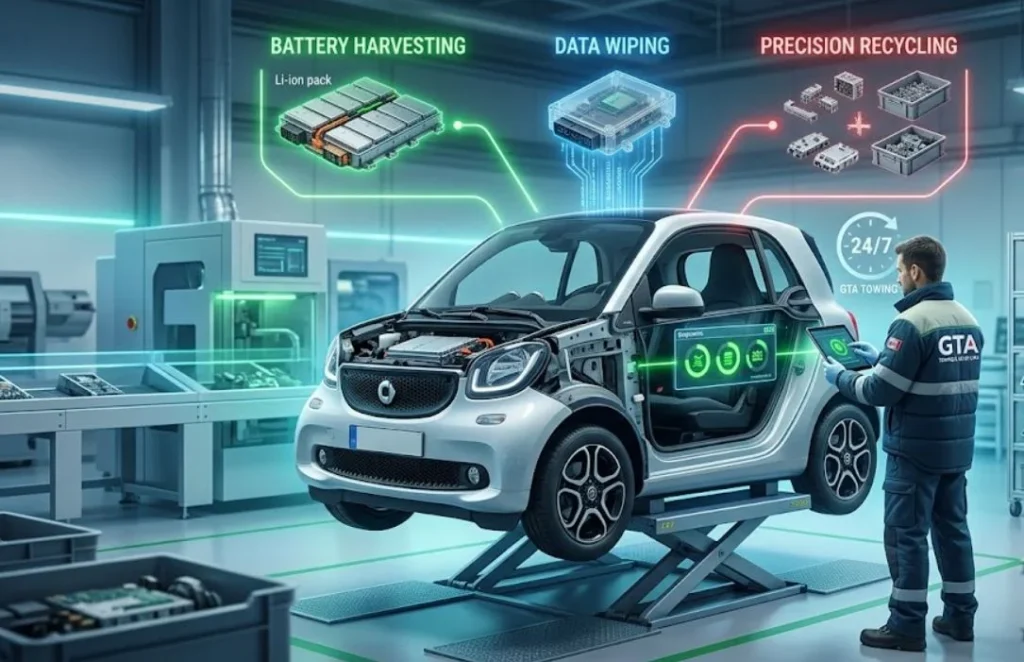
Beyond the electronics, the most significant difference lies in the powertrain. Whether it is a compact hybrid or a massive long-range electric SUV, these vehicles rely on high-voltage electrical architectures. The presence of these complex electronic systems and volatile battery setups means that processing a smart car requires specialized technical knowledge, specialized equipment, and precise execution.
The Scrapping Process of a Smart Car in Ontario
When a vehicle arrives at a progressive automotive recycling facility, it undergoes a rigid, multi-stage decommissioning process designed to prioritize safety and maximize material recovery.
The process begins with an advanced diagnostic scan. Technicians connect specialized scanning tools to the vehicle’s onboard diagnostic port to evaluate the health of the internal computers, microprocessors, and battery modules.
This tells the dismantling team exactly which electronic components are still functional and safe for resale. Next, the vehicle undergoes comprehensive digital data wiping to ensure the previous owner’s personal data is completely unrecoverable.
Once the digital safety checks are complete, the vehicle moves to the physical declassification phase. Technicians isolate and remove the high-voltage service disconnect plug, completely cutting off the electrical current from the main battery pack to the rest of the chassis.
With the electrical threat mitigated, the vehicle moves to the fluid evacuation bay. Here, high-powered, closed-loop vacuum systems safely extract all internal liquids, including specialized chemical coolants used to regulate battery temperatures, air conditioning gases, brake fluids, and windshield washer liquids.
The final phase involves precision manual dismantling. High-value electronic components, such as cameras, radar units, central processing modules, and infotainment screens, are carefully unbolted and cataloged. Finally, the massive lithium-ion battery pack is lowered from the bottom of the chassis using specialized non-conductive lifting tables, leaving the bare metal shell ready for the industrial shredder.
The Role of Technology in Scrapping Smart Cars
Technology is the very tool used to dismantle these modern vehicles. Modern auto wreckers utilize advanced automation, specialized software, and state-of-the-art sorting machinery to turn a junk car into reusable raw materials.
For example, inventory tracking software allows recyclers to cross-reference salvaged microchips and electronic modules with global automotive databases. This ensures that functional parts are immediately refurbished, listed online, and placed back into the supply chain, reducing the global demand for newly manufactured semiconductors.
Further down the recycling line, automated separation technology takes over. Once the stripped metallic frame is fed into a massive industrial shredder, the resulting fragments are sorted using powerful automated lines. High-intensity magnets separate the iron and steel, while advanced eddy current separators bounce non-ferrous metals like aluminum and copper into dedicated bins. High-speed optical sorting cameras even use near-infrared light to instantly detect, identify, and sort different types of automotive plastics by their chemical composition.
Challenges in Scrapping Smart Cars
The rapid adoption of smart technology has created several major bottlenecks for the traditional auto wrecking industry. The primary challenge is safety. The lithium-ion batteries found in modern electric and hybrid vehicles operate at voltages ranging from 400V to over 800V. A single misstep during the extraction process can cause severe electrical shock or trigger a catastrophic chemical reaction known as thermal runaway, which produces intense, self-sustaining battery fires that are incredibly difficult to extinguish.
Another growing challenge is the rapid obsolescence of automotive software. Unlike mechanical components like an engine block or an alternator, which can remain useful for decades, a first-generation smart car computer module from a decade ago might be completely incompatible with modern automotive networks.
This makes salvaging car electronics a fast-moving race against time, requiring recyclers to constantly update their knowledge bases to understand which components carry true secondary market value and which are purely destined for raw element extraction.
Environmental Impact and Sustainability
From a purely environmental perspective, advanced vehicle recycling is one of the most vital pillars of the modern circular economy. Every single component that is safely recovered from an old vehicle reduces the ecological damage caused by mining virgin raw materials.
This sustainability benefit is most apparent during electric vehicle battery recycling. The production of modern EV batteries requires intensive global mining for finite elements like lithium, cobalt, nickel, and manganese. Through highly specialized hydro-metallurgical recycling processes, specialized facilities can recover over 95% of these critical minerals from old, degraded battery cells, allowing manufacturers to create brand-new batteries without digging new mines.
Furthermore, batteries that are no longer strong enough to power a vehicle are frequently redirected into second-life battery storage applications. These refurbished automotive battery packs are linked together to create massive stationary energy storage banks for solar and wind farms, capturing excess clean energy during peak production hours and feeding it back into the local electrical grid when demand spikes.
Future of Smart Car Recycling in Ontario
As the province continues to move toward a more sustainable transportation network, the automotive recycling sector will undergo further transformation. We are already seeing the emergence of strict extended producer responsibility frameworks, which hold vehicle manufacturers legally accountable for the ultimate disposal and recycling of their vehicles at end-of-life.
Additionally, the industry is preparing for a massive wave of first-generation electric vehicles hitting scrap yards simultaneously. This predictable surge in volume is driving local investments in specialized training and automated battery processing facilities right here in Ontario. The scrap yard of tomorrow will look less like a grease-stained yard and much more like a high-tech cleanroom facility.
How GTA Towing & Scrap Cars Simplifies Your Vehicle Disposal
If you have a damaged, old, or completely non-functional vehicle sitting in your driveway, you do not need to worry about the logistical headaches of high-voltage handling or complex digital data wiping. At GTA Towing & Scrap Cars, located conveniently at 3091 Eglinton Ave E, Scarborough, ON M1J 2G1, Canada, we handle the entire process from start to finish.
We provide a seamless, stress-free vehicle disposal experience for drivers across the Greater Toronto Area. Whether your car is an aging hybrid with a dead battery pack or a completely wrecked traditional sedan, our team brings the technical expertise and specialized equipment required to manage the disposal safely and responsibly.
We operate 24/7, providing free towing, transparent paperwork transfers, and immediate cash on the spot. When you choose us, you are choosing a certified service that ensures your old car is processed in strict compliance with all Ontario environmental safety standards.
Frequently Asked Questions
How do I safely scrap a smart car or electric vehicle in the GTA?
You should never attempt to remove electronic modules, high-voltage cables, or battery packs yourself. To scrap an electric or smart vehicle safely, contact a professional service provider like GTA Towing & Scrap Cars. We deploy certified flatbed operators who can safely secure, transport, and process advanced vehicles using specialized safety protocols.
What happens to my personal data when I scrap a connected car?
When you sell your vehicle to a reputable modern auto wrecker, the vehicle undergoes a dedicated digital sanitization process. This involves resetting the electronic control units, wiping all stored navigation histories, clearing synchronized mobile phone contacts, and deleting any saved garage door opening codes to protect your privacy.
How is the cash value of a scrap smart car calculated?
Unlike older vehicles that are valued purely by total metal weight, smart car valuation involves an assessment of the vehicle’s onboard technology. The ultimate quote accounts for the resale value of functional sensors, infotainment components, valuable microchips, and the current commodity market value of the rare earth metals contained within the battery cells.
Do I need to sign over my vehicle ownership when scrapping a car in Ontario?
Yes. To legally scrap any vehicle in Ontario, you must provide the vehicle registration permit. You will sign the “Application for Transfer” portion on the back of the permit, which allows the recycling facility to officially notify ServiceOntario that the vehicle has been retired and taken off the road permanently.
Turn Your Old Car Into Instant Cash Today
Do not leave an old, damaged, or unwanted vehicle taking up valuable space on your property. Get a fast, accurate, and completely transparent quote for your vehicle right now. Contact the local experts at GTA Towing & Scrap Cars today by calling +1 647-473-6322 or visiting our location in Scarborough, Ontario, to schedule your free, same-day scrap car removal.