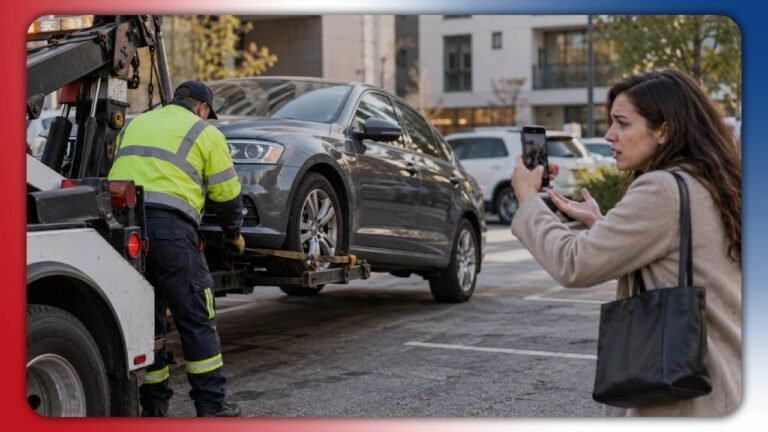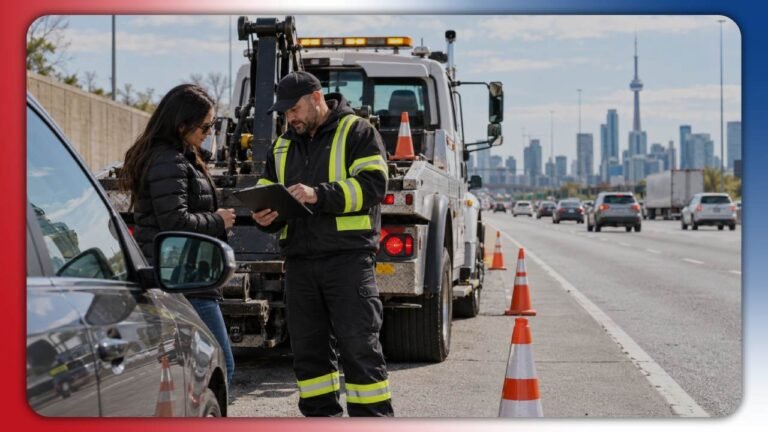

Your own insurer pays for towing after a car accident in Ontario when you are not at fault. Your collision coverage pays the share of fault you carry. You pay the tow operator directly when your policy lacks collision coverage.
Insurance adjusters decide fault, not police officers, using Ontario’s Fault Determination Rules. Fault then decides which policy covers the tow truck bill. The sections below cover 4 payment scenarios, 5 towing rights, and 5 claim steps for Greater Toronto Area (GTA) drivers.
Who Pays for Towing After a Car Accident in Ontario?
The payer for towing after a car accident depends on fault, which Ontario insurers set between 0% and 100%. Match your situation to 1 of the 4 scenarios below. Towing after a car accident travels with the property damage claim, so 1 fault percentage decides both.
When You Are Not at Fault (0% Fault)
Your insurer pays the tow bill through Direct Compensation Property Damage (DCPD) coverage. Your insurer then recovers the cost from the at-fault driver’s insurer. Pay the operator first and claim reimbursement, unless the towing company bills your insurer directly.
When You Share Fault (1% to 99%)
Your insurer splits the claim by fault percentage. DCPD covers the share you did not cause, and your collision coverage covers the share you caused. A driver 25% at fault carries 25% of the loss, and DCPD pays the remaining 75%.
When You Are Fully at Fault (100% Fault)
Your collision or all-perils coverage pays for towing after a car accident when you cannot drive the vehicle. Check your policy for towing distance caps, such as 31 miles (50km). Pay the extra distance yourself when the repair shop sits beyond the cap.
When the At-Fault Driver Is Uninsured or Unknown
Your own insurer handles the claim under collision coverage or Uninsured Automobile coverage. DCPD requires an identified, insured at-fault vehicle. Collect the other driver’s plate number, licence number, and insurance details at the scene.
How Does Fault Decide Who Pays for Towing After a Car Accident?
Your insurer decides fault, not the police officer at the scene. Adjusters match the collision to the diagrams in Regulation 668 of the Insurance Act, called the Fault Determination Rules. Fault then decides who pays for towing after a car accident.
Each driver receives a fault percentage between 0% and 100%. The rules ignore weather, road conditions, and lighting. A conflict between 2 rules, 100% fault versus 0% fault, produces a deemed 50% fault result.
Evidence still shapes the outcome. Submit photographs (vehicle damage, lane markings, traffic signals), the police report, and witness statements. The adjuster uses the evidence to pick the correct diagram.
A fault share of 25% or more can raise your premium at renewal, unless you hold accident forgiveness.
What Fault Percentages Look Like in 4 Common Collisions
Adjusters apply fixed percentages to common Ontario collisions. Each percentage also decides who pays for towing after a car accident.
- Rear-end collisions: the trailing driver usually carries 100% of the fault
- Left turns across traffic: the turning driver usually carries 100% of the fault
- Lane changes: the driver who changes lanes usually carries 100% of the fault
- Parking lot backing collisions: each driver carries 50% of the fault
Split results such as 75% and 25% apply when both drivers contributed to the collision.
How to Dispute a Fault Decision With Your Insurer
To dispute a fault decision with your insurer, follow 5 steps:
- Request a written explanation that names the Regulation 668 rule the adjuster applied.
- Gather evidence, such as dash camera footage, witness statements, and traffic camera images.
- Present the evidence to the adjuster, then ask for a claims supervisor.
- File a complaint through the internal complaints process of your insurer.
- Escalate to the General Insurance OmbudService (GIO) or the Financial Services Regulatory Authority of Ontario (FSRA).
Court remains the final option when the dispute stays unresolved.
What Does Car Insurance Cover for Towing After a Car Accident?
3 coverages pay for towing after a car accident in Ontario: collision, all-perils, and DCPD. Basic liability coverage pays nothing toward your own tow.
Collision and All-Perils Coverage
Collision coverage pays for damage from hitting vehicles or objects (parked cars, guardrails, utility poles), whatever the fault. All-perils coverage adds events such as fire, theft, and vandalism. Both coverages usually pay for towing after a car accident when you cannot drive the vehicle. Confirm the limits with your insurer.
Direct Compensation Property Damage (DCPD)
DCPD pays for vehicle damage when another driver carries part or all of the fault. The coverage applies to Ontario collisions where both drivers hold Ontario insurance.
Since January 2024, Ontario drivers can opt out of DCPD through Ontario Policy Change Form 49 (OPCF 49). Check your policy declarations page for an opt-out before you assume DCPD applies.
Roadside Assistance vs Accident Towing Coverage
Roadside assistance covers breakdowns (flat tires, dead batteries, empty fuel tanks), not collisions. Accident towing sits under collision coverage, all-perils coverage, or a towing endorsement. Ontario Policy Change Form 35 (OPCF 35) adds roadside assistance with a dollar cap per tow. Call your insurer from the scene to confirm which coverage applies.
Why Insurer-Approved Towing Companies Speed Up Reimbursement
Approved towing companies usually bill the insurer directly, which speeds up reimbursement. Most insurers keep a list of preferred towing companies under contract. Unapproved companies can trigger claim delays or a denied reimbursement. Ask your insurer for approved companies before you book towing after a car accident.
GTA Towing provides insurance vehicle towing for insurance vehicles, car dealers, and auctions across the GTA.
What Rights Do You Have Under Ontario Towing Law?
The Towing and Storage Safety and Enforcement Act (TSSEA) gives you 5 rights during towing after a car accident. The Act took effect on January 1, 2024, and the Ministry of Transportation of Ontario (MTO) certifies every tow operator.
- Refuse any tow until you sign a Consent to Tow form, because operators cannot charge without your consent.
- Request the maximum rate schedule before signing, because operators cannot charge over the maximum rates.
- Choose the towing company and the destination, unless police direct the tow.
- Ask to see the operator’s certificate, whose number appears on every tow truck.
- Pay by credit card or debit card and demand an itemized invoice and receipt.
How to Read a Consent to Tow Form Before You Sign
To read a Consent to Tow form before you sign, check 4 items:
- The operator’s name and certificate number
- The destination address
- The maximum rates
- The signature line
Never sign a blank form. Operators must give you an unaltered copy and a list of your rights. Keep the copy with your insurance claim documents.
Who Controls the Tow When Police Arrive
Police direct towing after a car accident when officers must clear a lane. Police also direct towing when injuries prevent you from giving consent.
Ontario Provincial Police (OPP) guidelines for the GTA allow 1 tow truck per vehicle unless officers request more. Tow trucks parked within 656 feet (200m) of a collision scene without a request must leave.
Police-requested tows fall into 2 types. Non-legislated tows cover vehicles whose owners cannot authorize a tow. Legislated tows impound vehicles after serious violations (stunt driving, impaired driving), and the OPP must authorize release.
Operators must give you and the police the phone numbers of the towing company and the impound facility. Ask the officer to call the towing company you or your insurer prefer.
How Much Does Towing After a Car Accident Cost in Ontario?
A standard Ontario tow starts at $75 and exceeds $150 in some areas. Towing after a car accident costs more when the scene, the vehicle, or the time of day adds work.
What the Hook-Up Fee and Per-Kilometre Rate Cover
The base hook-up fee covers dispatch, loading, and the first 3 to 6 miles (5 to 10km). Per-kilometre charges then run $3 to $6 per kilometre ($4.83 to $9.66 per mile). A 12-mile (19km) tow adds 5.6 miles (9km) of charges after the first 6 miles (10km): $27 to $54.
6 Factors That Raise the Cost of Towing After a Car Accident
- Flatbed trucks, which all-wheel-drive vehicles (Subaru Outback, Toyota RAV4) often need
- Electric vehicles (Tesla Model 3, Nissan Leaf, Chevrolet Bolt), which cost more to tow
- Damaged cars (flipped sedans, crushed SUVs), which cost more to recover
- Awkward locations (underground garages, ditches, highway shoulders)
- Night, weekend, and holiday timing
- Daily storage fees at the tow yard
How Maximum Rates Cap Your Towing Bill
Operators cannot charge over the maximum rates on the posted schedule. A Toronto driver received a $4,300 quote in 2017 for a post-collision tow. Legal action cut the bill to $1,594, and the 2024 rate rules now block quotes over the posted maximum. Ask the operator for the total in writing before the truck moves.
How to Claim Towing Costs Back After a Car Accident
To claim towing costs back after a car accident, complete 5 steps:
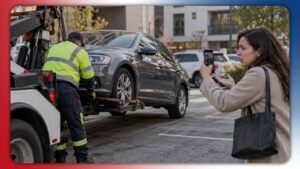
- Photograph the vehicle on the tow truck, the scene, and the damage before the operator leaves.
- Call your insurer from the scene and confirm towing coverage before the truck loads your vehicle.
- Pay the operator by credit card and keep the itemized invoice, consent form, and receipt.
- Submit the claim through your insurer’s app, online portal, or claims adjuster with the police report and photographs.
- Follow up with the adjuster after 10 business days if no reimbursement arrives.
Keep 6 documents in your claim file for towing after a car accident:
- Consent to Tow form
- Itemized invoice
- Payment receipt
- Police report
- Photographs of the scene and damage
- Other driver’s name, plate number, and insurance details
Insurers process complete claims for towing after a car accident in 5 to 10 business days. Insurers deny claims for 3 reasons: late notice, unapproved towing companies, and missing receipts.
Where Does Your Car Go After the Tow, and Who Pays for Storage?
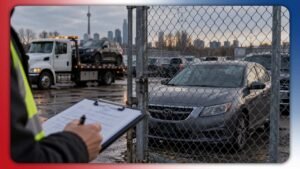
Direct the tow truck to a repair shop, dealership, or your home to avoid daily storage fees. Towing after a car accident ends at the destination you name, unless police direct otherwise.
Police can direct you to a Collision Reporting Centre (CRC) before any repair shop. Confirm the destination’s name, address, and phone number before the truck leaves.
How Storage Fees Build Up
Storage operators charge a daily fee for every day your vehicle stays on the lot. Operators must post the maximum rate schedule at every premises. After-hours access can add extra fees. Ask for the daily rate in writing and confirm coverage with your insurer the same day.
What Happens When Your Car Is a Total Loss
Your insurer can leave a write-off in storage until the claim settles. Confirm in writing who pays the extra towing and storage fees. Request the final towing and storage invoices before you accept the settlement. Remove your licence plates and belongings, then sign the release forms.
Ask the insurer whether you keep the salvage. Owners who keep the wreck can request a cash for cars offer from a GTA buyer.
How to Avoid Towing Scams After a Collision
To avoid towing scams after a collision, watch for 4 red flags:
- Tow trucks that arrive without a call from you
- Drivers who push an immediate tow
- Operators who refuse upfront pricing or an itemized invoice
- Referrals to specific repair shops, lawyers, or storage yards
Scams cluster around towing after a car accident because emotions run high. Accident chasers (opportunistic tow operators) collect referral fees from repair shops, and shops recover the fees through inflated repair bills.
Tow drivers cannot solicit you for storage providers, legal services, or health professionals. Report violations through the MTO towing complaint portal.
What Should You Do After a Collision? Quick-Reference Table
The table below lists 8 tasks for towing after a car accident, with timing, method, and difficulty.
| Task | Timing | Method | Difficulty |
| Photograph the scene | Before any vehicle moves | Phone camera: damage, plates, signs, road | Easy |
| Notify your insurer | From the scene, before loading | Insurer app or claims phone line | Easy |
| Request the tow | After police clear the scene | Your chosen company or the insurer’s approved company | Easy |
| Sign the Consent to Tow form | Before the truck moves | Check name, certificate number, destination, rates | Medium |
| Confirm the destination | At loading | Get the name, address, and phone of the yard or shop | Easy |
| Pay and collect paperwork | At drop-off | Credit card; itemized invoice and receipt | Easy |
| File the towing claim | Same day or next day | Insurer portal with invoice, photographs, police report | Medium |
| Dispute the fault decision | After the adjuster decides | Written explanation, evidence, then GIO or FSRA complaint | Hard |
Frequently Asked Questions About Towing After a Car Accident
Does car insurance cover towing after a car accident in Ontario?
Yes. Collision, all-perils, and DCPD coverage pay for accident towing, while basic liability coverage does not. Confirm your towing distance cap, such as 31 miles (50km), with your insurer.
Can you choose your own tow truck after a collision?
Yes. You choose the towing company and the destination unless police direct the tow. Ask the officer to call your preferred company or your insurer’s approved company.
Does the at-fault driver pay for towing and storage fees?
Yes, indirectly. The at-fault driver’s insurer repays your insurer when you hold 0% fault. Partial fault shifts a share of the cost to your own coverage.
Can a tow company charge you without a signed consent form?
No. Operators cannot charge for a tow you did not authorize. Police-initiated tows follow separate rules.
How long does an insurer take to reimburse towing costs?
5 to 10 business days after you submit complete documents for towing after a car accident. Follow up with the adjuster after 10 business days.
Get Fast, Reliable Help With Towing After a Car Accident in the GTA
Fault decides who pays for towing after a car accident. Ontario law protects your right to choose the tow truck. Photograph the scene, sign nothing blank, and call your insurer before the truck loads your vehicle. Review your policy for DCPD and collision coverage before your next drive. GTA Towing dispatches 24/7 from Scarborough. Crews move accident vehicles from the scene to a Collision Reporting Centre or collision repair centre. Call (647) 473-6322 or book accident vehicle towing today.