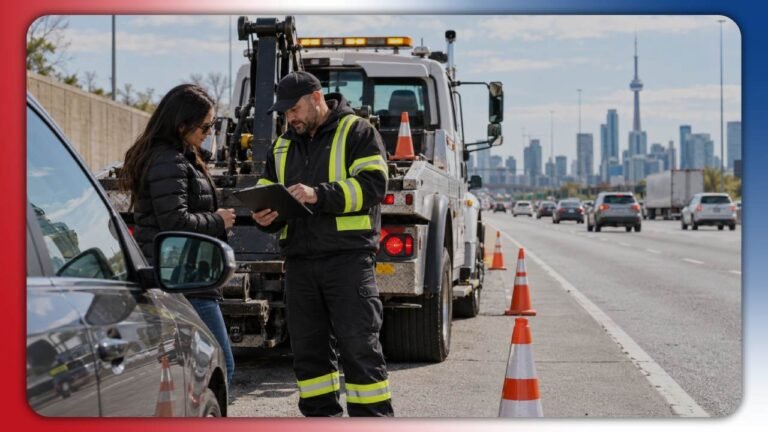

Steer to the right shoulder and switch on your hazard lights when your car breaks down on highway. Stay buckled inside your car, then call 911 if you feel unsafe or call roadside assistance for a tow.
A car breaks down on the highway without notice. Ontario’s 400-series highways post a speed limit of 100 km/h (62 mph) on most sections. This 2026 guide covers the steps, the details to tell a dispatcher, and the signs of a dishonest tow operator.
What to Do the Moment Your Car Breaks Down on Highway
Lift off the accelerator and switch on your hazard lights the moment your car breaks down on the highway. Avoid hard braking, since sudden stops raise the risk of a rear-end collision.
Many breakdowns start with warnings: dashboard lights (check engine, battery, oil pressure), power loss, grinding noises, or smoke. Pull over at the first warning instead of driving on.
How to Steer Your Car to the Shoulder Safely
To steer your car to the shoulder safely, signal early and check your mirrors before each lane change. Cross 1 lane at a time. Aim for the right shoulder, because the right lanes carry slower traffic and offer a clearer exit.
Park on the highway shoulder at least 6 feet (1.8m) beyond the white edge line when space allows. Turn your front wheels away from the road, then set the parking brake.
Take the nearest exit if your car still rolls, since ramps and service roads give more space than shoulders. Use the left shoulder only when crossing the right lanes is unsafe.
How to Handle a Breakdown When the Highway Has No Shoulder
To handle a breakdown with no shoulder, keep your hazard lights on and stay inside with your seatbelt fastened. Call 911 immediately, because a car stopped in a live lane is a collision risk.
Bridges, construction zones, and narrow ramps often lack shoulders. Never step into traffic, and never try to push the car.
How to Make Your Car Visible After Your Car Breaks Down on the Highway
To make your car visible after your car breaks down on the highway, turn on your hazard lights first. Add 3 more visibility tools when you can do so safely:
- Turn on your interior dome light at night.
- Raise the hood only when you can exit on the side away from traffic.
- Place reflective triangles about 100 feet (30m) behind your car.
Park on a straight, flat section away from curves and hill crests when you have a choice. Skip flares when you smell gasoline, because spilled fuel ignites on contact with flames.
Should You Stay Inside When Your Car Breaks Down on the Highway?
Stay inside with your seatbelt fastened when your car breaks down on the highway, unless smoke or flames threaten you. The Insurance Information Institute warns drivers against exiting a vehicle to inspect damage on a busy highway.
When to Stay Inside Your Vehicle
Stay inside when your car breaks down on the highway in any of 3 conditions. Conditions include a narrow shoulder, heavy traffic, and low visibility from rain, snow, or darkness.
Lock the doors and keep the windows closed. Call for help from the driver’s seat.
When to Exit Your Vehicle Immediately
Exit at once when your car breaks down on the highway and smoke, flames, or a gasoline smell appears. Leave through the door facing away from traffic. Walk at least 100 feet (30m) from the car and stand behind the guardrail.
Take your phone and your passengers, including children and pets. Call 911 from your safe position.
Who to Call When Your Car Breaks Down on the Highway in Ontario
Your first call depends on the danger when your car breaks down on the highway. Call 911 for danger, injury, fire, or a stopped car in a live lane.
Call the Ontario Provincial Police (OPP) at 1 888 310-1122 for non-emergency highway help. Some mobile carriers also offer *OPP (*677) for non-emergency calls.
Make these 4 calls in order after you stop safely:
- Call 911 or the OPP to report your location.
- Call your roadside assistance provider, such as the Canadian Automobile Association (CAA) or your insurer.
- Call a Greater Toronto Area (GTA) tow company, such as GTA Towing & Scrap Cars at (647) 473-6322.
- Call a family member or friend and share your location.
What to Tell the Dispatcher About Your Location
To tell the dispatcher your location, give 4 details: highway number, travel direction, nearest exit, and closest landmark. Landmarks include overpasses, bridges, and ONroute service centres.
Send a map pin from your phone’s Global Positioning System (GPS) to your contact. Add your vehicle’s make, colour, and licence plate, plus the number of passengers.
How to Choose a Safe Tow Truck After Your Car Breaks Down on the Highway
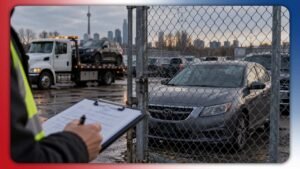
To choose a safe tow truck, get the company name, a written estimate, and the destination before hookup. Ontario’s Towing and Storage Safety and Enforcement Act (TSSEA) has regulated towing since 1 January 2024. The law requires written estimates before towing begins.
Predatory operators exploit stressed drivers when a car breaks down on the highway. Refuse any driver who:
- Arrives without your call
- Pressures you to sign before naming a price
- Skips the written estimate
- Declines to name the destination
Request a flatbed truck for electric vehicles (EVs) such as the Tesla Model 3, Nissan Leaf, and Hyundai Ioniq 5. Flatbeds also suit all-wheel-drive (AWD) models such as the Subaru Outback and Honda CR-V.
A flatbed lifts all 4 wheels off the road and protects the battery and drivetrain.
GTA Towing & Scrap Cars offers Toronto flatbed towing 24/7 on the Gardiner Expressway, Don Valley Parkway, and Highway 401.
What to Do After the Tow Truck Arrives on the Highway
Complete these 5 checks before the truck leaves the shoulder:
- Confirm the company name on the truck matches the company you called.
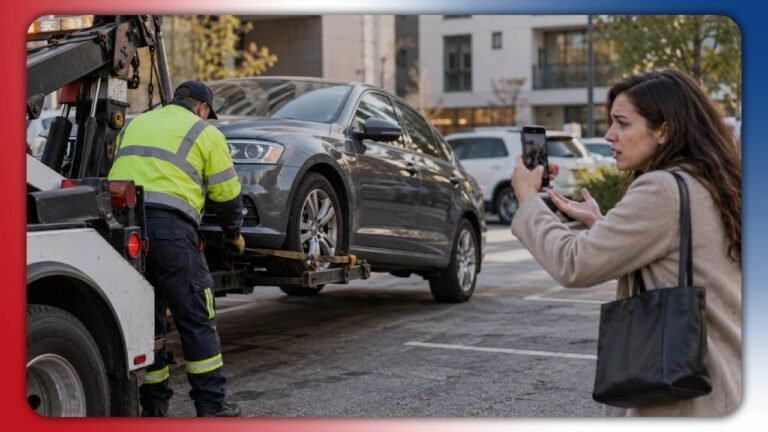
- Photograph your car from 4 sides before loading.
- Read the written estimate before you sign.
- Remove valuables, such as wallets, laptops, and phones.
- Ask for the destination address in writing.
Tell the repair shop what happened when your car breaks down on the highway. Name the warning lights, sounds, and smells you noticed before the stop.
Keep every receipt for your insurer or roadside assistance provider.
How to Stay Safe While You Wait After Your Car Breaks Down on the Highway
To stay safe while you wait, keep your seatbelt on and your doors locked until help arrives. Help can take an hour or longer when your car breaks down on the highway in heavy traffic.
- Turn off the radio, air conditioning, and extra lights to save battery power.
- Keep children buckled in car seats and pets in carriers.
- Watch your mirrors for fast-approaching vehicles.
- Update your contact every 15 minutes with your status and location.
Stay with your car until your tow truck driver, a police officer, or a roadside technician arrives. Confirm each visitor’s identity through the dispatcher you called.
Why Your Car Breaks Down on the Highway: 6 Common Causes
A car breaks down on the highway from 6 common causes:
- Dead batteries and failed alternators (the part that recharges the battery)
- Flat or damaged tires from potholes, nails, and road debris
- Overheating engines from coolant leaks, worn hoses, or failed water pumps
- Empty fuel tanks or the wrong fuel type (diesel in a gasoline engine)
- Starter motor failure after thousands of kilometres of use
- Electrical faults in sensors, fuses, and ignition switches
Routine servicing (oil changes, battery tests, tire rotations) catches many of these causes early. Book an inspection before every long trip and every winter.
What to Do When Your Car Breaks Down on the Highway From 3 Common Causes
Match your response to the cause: flat tires, overheating engines, or dead batteries.
How to Handle a Flat Tire on the Highway
To handle a flat tire on the highway, ease onto the shoulder slowly and stop on level ground. Change the tire only when the flat sits on the side away from traffic. Call roadside assistance when the flat faces traffic.
Check the spare’s air pressure before installation, since spares sit in trunks for years.
How to Handle an Overheating Engine
To handle an overheating engine, pull over, switch off the engine, and wait 30 minutes before opening the hood. Never open the radiator cap on a hot engine, because pressurized coolant above 100°C (212°F) causes burns.
Call for a tow when the temperature gauge returns to the red zone.
How to Handle a Dead Battery or an Empty Fuel Tank
To handle a dead battery or an empty fuel tank, call roadside assistance instead of walking along the highway. GTA Towing & Scrap Cars lists battery boosts, fuel delivery, and tire changes among the company’s services.
Call a tow after a wrong-fuel fill-up (diesel in a gasoline car), because running the engine damages the fuel system.
Quick Reference: Highway Breakdown Tasks, Timing, Method, and Difficulty
The table below lists 8 tasks, ordered by timing, to follow when your car breaks down on the highway.
| Task | Timing | Method | Difficulty |
| Lift off the accelerator | First 5 seconds | Coast and avoid hard braking | Easy |
| Switch on hazard lights | First 10 seconds | Press the red triangle button | Easy |
| Steer to the right shoulder | First 30 seconds | Signal, check mirrors, cross 1 lane at a time | Moderate |
| Set the parking brake | Within 1 minute | Turn front wheels away from the road | Easy |
| Call 911 or the OPP | Within 2 minutes | Phone call from the driver’s seat | Easy |
| Place reflective triangles | Within 5 minutes, only when safe | Set 2 triangles 100 feet (30m) behind the car | Moderate |
| Book a tow truck | Within 10 minutes | Request a written estimate and a flatbed for EVs | Easy |
| Change a flat tire | Only off the road | Change only on the side away from traffic | Hard |
What to Keep in Your Car to Prepare for a Highway Breakdown
To prepare for a highway breakdown, pack an emergency kit with these 8 items:
- A fully charged power bank with a phone cable
- 2 reflective triangles
- A flashlight with spare batteries
- 4 litres (1 gallon) of drinking water
- Booster cables at least 12 feet (3.6m) long
- A tire pressure gauge and a compact air pump
- A first aid kit with bandages, gauze, and gloves
- Warm layers (wool blanket, gloves, toque)
A packed kit keeps you safe and comfortable when your car breaks down on the highway. Store the kit in the trunk and check first aid expiry dates every 6 months.
Check your tire pressure monthly and match the number on the driver’s door sticker. Service your battery, belts, and coolant (antifreeze) before each winter.
How to Handle a Winter Highway Breakdown in Ontario
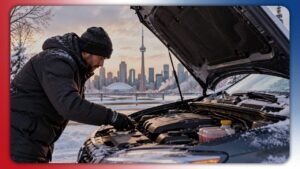
To handle a winter breakdown in Ontario, stay inside your car and call for help immediately. Run the engine for 10 minutes each hour for heat.
Subzero cold makes waiting riskier when your car breaks down on the highway.
Clear snow from the exhaust pipe first, since a blocked pipe sends carbon monoxide into the cabin. Open a window 1 inch (2.5cm) for fresh air. Keep your fuel tank at least half full from November to March.
Drivers stranded near Highway 401, the Allen Expressway, and Sheppard Avenue can book a North York towing service 24/7.
What to Do When Repairs Cost More Than Your Car Is Worth
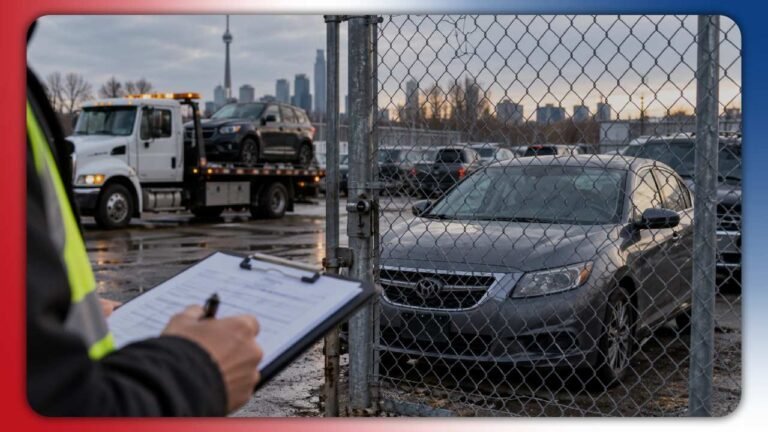
Scrap the vehicle for cash when repairs cost more than the car is worth. A highway breakdown often exposes expensive failures such as blown engines, failed transmissions, and cracked cylinder heads.
GTA Towing & Scrap Cars lists $200 to $800+ in cash for most Toronto scrap cars. The company charges $0 for towing on scrap car removal across Toronto and the GTA. The company adds no fuel surcharges or distance fees.
Final cash offers depend on vehicle type, condition, and current steel and aluminum prices. Call (647) 473-6322 for a scrap car quote before you approve an expensive repair.
Stay Safe the Next Time Your Car Breaks Down on the Highway
5 actions keep you safe when your car breaks down on the highway. Coast to the shoulder, switch on your hazards, stay buckled, call for help, and request a written tow estimate.
Save the number for GTA Towing & Scrap Cars, (647) 473-6322, before your next 2026 road trip. Call 24/7 for emergency towing, or ask about cash for scrap cars when repairs cost more than the vehicle.
Frequently Asked Questions When Your Car Breaks Down on the Highway
Should I stay inside when my car breaks down on the highway?
Yes. Stay inside with your seatbelt fastened unless smoke, flames, or fuel odours threaten you. Exit through the door facing away from traffic when you must leave.
Can I walk to the next exit when my car breaks down on the highway?
No. Never walk along a highway, because passing traffic at 100 km/h (62 mph) leaves no reaction time. Call 911 or the OPP instead.
Does insurance pay when my car breaks down on the highway?
No for repairs. Standard car insurance excludes mechanical breakdown, so a tow or repair bill falls on you. Roadside assistance plans from insurers and CAA cover towing, battery boosts, and fuel delivery.
Can I push my car off the highway myself?
No. Never push your car, because stepping onto the road exposes you to traffic. Stay inside and call for a tow.
Should I accept help from a stranger?
No. Stay locked inside and ask the stranger to call 911 for you. Open the window 1 inch (2.5cm) to talk.