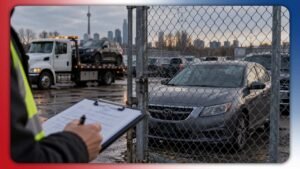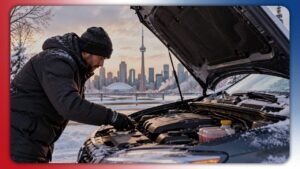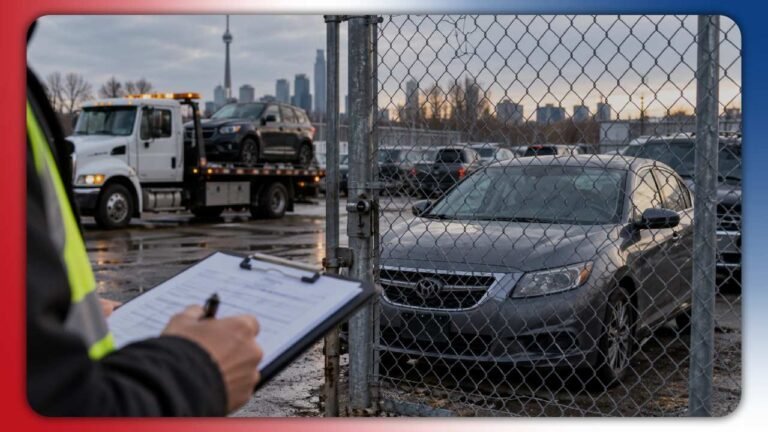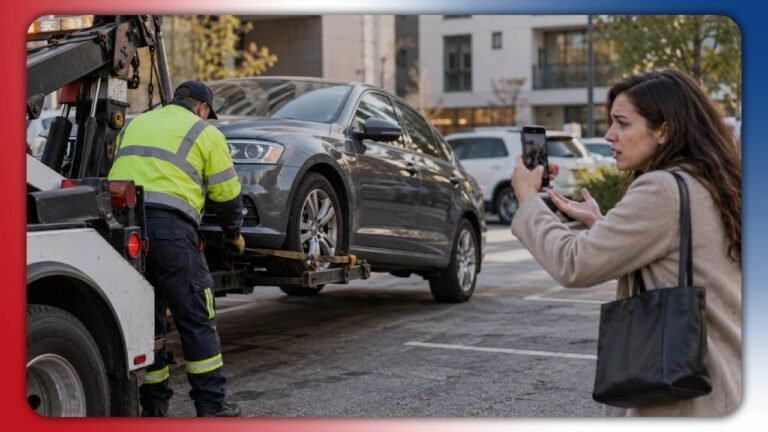

Use a flatbed for all-wheel drive (AWD), electric, damaged, and lowered vehicles. Use a wheel lift for short tows of 2-wheel-drive cars that roll freely. Flatbed towing vs wheel lift comes down to wheel contact. A flatbed lifts all 4 wheels, and a wheel lift lifts 2.
Every section applies to Greater Toronto Area (GTA) drivers. You get vehicle rules, 2026 costs in Canadian dollars (CAD), winter advice, and Ontario consent rules.
What Is the Difference Between Flatbed Towing vs Wheel Lift?
The difference is wheel contact. A flatbed keeps 0 wheels on the road, and a wheel lift keeps 2. Truck size, loading speed, and vehicle protection all follow from that single difference.
Flatbed towing vs wheel lift also changes your bill, the space the truck needs, and the strain on your drivetrain. GTA operators run both truck types, so you can request the method that fits your vehicle.
How a Flatbed Tow Truck Works
A flatbed tow truck tilts a hydraulic bed to ground level, and the operator winches or drives the vehicle on. Operators also call this truck a rollback or slide-back. The bed slides back and forms a ramp.
The operator then secures the vehicle with 4 tie-down straps or chains. Most car-carrier beds run about 20 feet (6m) long, so the truck needs a clear lane for loading.
How a Wheel Lift Tow Truck Works
A wheel lift tow truck slides a metal yoke under 2 tires and raises them with a hydraulic hoist. Operators also call the yoke a spectacle lift or underlift. The yoke touches only the tires.
The operator lifts the driven wheels. Front-wheel drive cars lift at the front, and rear-wheel drive cars lift at the rear. The other 2 wheels roll on the pavement. Modern yokes replaced old hook-and-chain trucks, which gripped the bumper and frame.
What Are the Pros and Cons of Flatbed Towing vs Wheel Lift?
Flatbeds offer maximum protection, and wheel lifts offer maximum speed and access. Flatbed towing has 5 defining traits:
- Protection: 0 wheels touch the road
- Range: any distance, including 100 km (62 miles) tows
- Fit: AWD, electric, motorcycle, and damaged vehicles
- Cost: $25 to $75 more than a wheel lift
- Access: struggles in low garages and narrow lanes
Wheel lift towing has 5 defining traits:
- Speed: hooks up faster than a flatbed loads
- Access: fits tight garages, laneways, and parallel-parked spots
- Cost: charges less for short local tows
- Protection: leaves 2 wheels rolling on the road
- Limits: excludes AWD, electric, lowered, and damaged vehicles
Which Vehicles Need Flatbed Towing vs Wheel Lift Towing?
AWD, four-wheel drive (4WD), electric, luxury, lowered, and collision-damaged vehicles need a flatbed. Front-wheel drive and rear-wheel drive cars in working condition accept a wheel lift for short tows.
Flatbed towing vs wheel lift rules depend on 3 facts: drive type, ground clearance, and vehicle condition.
Why Do AWD and 4WD Vehicles Need a Flatbed?
AWD and 4WD systems link all 4 wheels through 1 drivetrain. Rolling just 2 wheels strains the center differential and transfer case. Examples include the Subaru Outback, Toyota RAV4 AWD, Audi Q5, and Ford F-150 4×4.
A wheel lift works on these vehicles only when 2 towing dollies (small wheeled cradles) support the rolling wheels. Book a flatbed to remove that risk.
Why Do Electric Vehicles Need a Flatbed?
Electric vehicle (EV) motors spin with the wheels, so a wheel lift tow forces the motor to turn without control. Examples include the Tesla Model 3, Hyundai Ioniq 5, Ford Mustang Mach-E, and Nissan Leaf.
Request a flatbed for every EV tow. Hybrids such as the Toyota Prius also need a flatbed.
Why Do Lowered and Damaged Vehicles Need a Flatbed?
Sports cars with less than 5 inches (13cm) of ground clearance scrape the bumper on a wheel lift yoke. Examples include the Porsche 911 and a lowered Honda Civic.
Bent axles, broken steering, and seized brakes stop a vehicle from rolling safely. A sedan after a Highway 401 collision needs a flatbed for the same reason.
Do Motorcycles Need a Flatbed?
Yes. Motorcycles need a flatbed with wheel chocks and soft tie-down straps, because a wheel lift cannot cradle 2 wheels. Examples include the Harley-Davidson Street Glide, Honda Gold Wing, and Yamaha MT-07.
When Is a Wheel Lift Tow the Right Choice?
A wheel lift is right for short local tows of 2-wheel-drive cars that roll freely and clear the yoke. Wheel lift trucks are smaller than flatbeds, so wheel lifts reach places flatbeds cannot. Flatbed towing vs wheel lift favours the wheel lift in 4 situations:
- Parking garages with posted clearances near 6.5 feet (2m)
- Parallel-parked cars boxed in by 2 other vehicles
- Highway shoulders where operators must clear lanes fast
- Narrow laneways and driveways with tight turns
GTA Towing & Scrap Cars also performs condo garage extraction in Toronto with the truck that fits the ceiling height.
How to Choose Wheel Lift Towing for Tight Spaces
To choose wheel lift towing for a tight space, confirm 3 facts before you call:
- Measure the ceiling height in feet and meters, such as 6.5 feet (2m).
- Confirm the drive type, such as front-wheel drive on a Toyota Corolla.
- Check that all 4 wheels turn and the steering wheel moves.
Give all 3 facts to the dispatcher, and the dispatcher picks the truck.
Which Is Better for Accident Recovery: Flatbed Towing vs Wheel Lift?
Flatbed towing is better for accident recovery, because collision damage often locks wheels and bends axles. A flatbed carries the wrecked vehicle without any wheel rolling.
Flatbed towing vs wheel lift changes at a live scene. A wheel lift clears a lane faster, but only when all 4 wheels turn.
Police direction overrides your right to choose the company at a collision scene. The operator still follows Ontario rate and invoice rules.
How Does Distance Change Flatbed Towing vs Wheel Lift?
Tows longer than 30 km (19 miles) favour a flatbed. A wheel lift keeps 2 tires spinning for the entire trip. Tire wear, bearing heat, and road debris add up over distance.
Toronto to Ottawa spans about 450 km (280 miles), and a flatbed carries the vehicle the whole way. Ontario long-distance rates typically run $2.50 to $5.00 per km ($4.02 to $8.05 per mile).
Flatbed towing vs wheel lift stays close in price on tows under 10 km (6 miles). GTA Towing & Scrap Cars also offers long-distance towing across Ontario.
How Much Does Flatbed Towing Cost Compared to Wheel Lift Towing?
Flatbed towing costs $25 to $75 more than wheel lift towing for the same distance in the GTA.
GTA operators charge a $75 to $150 base hook-up fee. Distance adds $3 to $6 per km ($4.83 to $9.66 per mile). The base fee usually covers the first 5 to 10 km (3 to 6 miles).
Flatbed towing vs wheel lift pricing follows 1 formula: base fee plus distance charge. Take a 15 km (9 miles) tow. The base fee is $100 for the first 10 km (6 miles), and extra distance costs $4 per km. The wheel lift total is $120. Add a $50 flatbed premium, and the flatbed total reaches $170.
After-hours calls and storage fees cost extra. A transfer case repair on an AWD vehicle costs more than $1,000 CAD, so the flatbed premium protects your money.
Ontario operators file maximum rates with the province. Ask for the filed rate schedule before you sign.
Ask 3 questions before you agree to a price: What does the base fee cover? What is the per km rate? Does a flatbed premium apply?
How to Choose Between Flatbed Towing vs Wheel Lift Before You Call
To choose between flatbed towing vs wheel lift, check 4 facts in this order:
- Check vehicle condition: book a flatbed if wheels, steering, or brakes fail.
- Check drive type: book a flatbed for AWD, 4WD, and electric vehicles.
- Check ground clearance: book a flatbed below 5 inches (13cm).
- Check tow distance: book a wheel lift only for short local tows.
What Should You Tell the Dispatcher?
Tell the dispatcher 5 facts so the correct truck arrives on the first trip. Clear answers settle flatbed towing vs wheel lift before the truck leaves the yard.
- Year, make, and model, such as a 2021 Subaru Outback
- Drive type, such as AWD, 4WD, front-wheel drive, or rear-wheel drive
- Vehicle condition, such as locked wheels or flat tires
- Exact location, such as level P3 of a condo garage
- Preferred tow method, either flatbed or wheel lift
How to Check a Tow Operator’s Ontario Certificate
To check a tow operator’s Ontario certificate, read the operator name and certificate number printed on the truck. The Towing and Storage Safety and Enforcement Act (TSSEA) has required certificates since January 1, 2024.
Ask for the Consent to Tow form before hook-up. Without your signed consent, the operator cannot charge you, unless a roadside assistance membership or police direction applies. You can also request a free estimate, and the operator must give an itemized invoice before you pay.
How to Prepare Your Vehicle for a Flatbed or Wheel Lift Tow
To prepare your vehicle for a flatbed or wheel lift tow, complete 5 steps before the driver arrives:
- Photograph all 4 sides of the vehicle for damage records.
- Remove valuables, such as wallets, laptops, and garage remotes.
- Hand the driver the key or fob so the steering stays unlocked.
- Read the Consent to Tow form, including price, destination, and services.
- Sign the form only after the total matches the quote.
The 5 steps protect you under either option in flatbed towing vs wheel lift.
Which Tow Method Works Best in Ontario Winters?
Flatbed towing works best in snow, ice, and slush, because the bed keeps all 4 wheels off slick pavement. A wheel lift leaves 2 wheels rolling. The rolling wheels slide on black ice along Highway 401 and the Don Valley Parkway.
Wheel lift trucks still win in plowed-in streets, where snowbanks narrow the lane. Flatbed towing vs wheel lift also matters for stuck vehicles. A flatbed winch pulls the vehicle out of a snowbank before loading.
GTA Towing & Scrap Cars dispatches emergency towing in Markham, Richmond Hill, and Scarborough around the clock. Arrival typically takes 30 to 60 minutes.
Cold weather adds 2 checks. Tell the dispatcher about a frozen parking brake, because a frozen brake locks a wheel and blocks a wheel lift. Tell the dispatcher about snow around the wheels, because the operator must clear 1 path before loading.
Flatbed Towing vs Wheel Lift: Which Method Fits Each Job?
Use the table to match your job to the correct truck in flatbed towing vs wheel lift. Difficulty rates the operator’s loading effort.
| Task | Best Method | Timing and Distance | Difficulty |
| Tow an AWD SUV such as a Subaru Outback | Flatbed | Any distance | Medium |
| Tow an EV such as a Tesla Model 3 | Flatbed | Any distance | Medium |
| Tow a lowered sports car such as a Porsche 911 | Flatbed | Any distance | High |
| Clear a collision-damaged sedan from Highway 401 | Flatbed | Any distance | High |
| Tow a motorcycle such as a Honda Gold Wing | Flatbed | Any distance | Medium |
| Move a front-wheel drive Toyota Corolla from a low garage | Wheel lift | Under 10 km (6 miles) | Low |
| Extract a boxed-in, parallel-parked sedan | Wheel lift | Under 10 km (6 miles) | Low |
| Haul a non-running Chevrolet Malibu to a scrapyard | Flatbed | Any distance | Medium |
Ask the dispatcher to confirm the method by name before hook-up.
Can You Tow a Scrap or Non-Running Car With a Wheel Lift?
Yes, a wheel lift tows a scrap car only when all 4 wheels roll and the frame stays intact. Book a flatbed for seized engines, missing wheels, and collision wrecks.
Flatbed towing vs wheel lift for scrap cars depends on 1 test: do all 4 wheels roll? Junk vehicles such as a 2008 Chevrolet Malibu with a dead transmission need a flatbed. Bring your Ontario vehicle ownership to the pickup.
Operators slide a car with locked or missing wheels onto the bed with wheel skates, which are small wheeled plates.
GTA Towing & Scrap Cars tows scrap vehicles for free, so you pay no flatbed premium when you sell.
Flatbed Towing vs Wheel Lift FAQs
Is flatbed towing safer than wheel lift towing?
Yes. In flatbed towing vs wheel lift, the flatbed wins on safety because 0 wheels touch the road. Wheel lift towing stays safe only for 2-wheel-drive cars in working condition.
Can you tow an AWD vehicle with a wheel lift?
No. Book a flatbed for AWD vehicles. A wheel lift works only when 2 towing dollies support the wheels that stay on the road.
Does flatbed towing cost more than wheel lift towing?
Yes. Flatbed towing adds $25 to $75 CAD for the same distance. A transfer case repair costs more than $1,000 CAD.
Can a wheel lift damage your car?
Yes, on the wrong vehicle. A wheel lift damages AWD, electric, and low-clearance vehicles. A working 2-wheel-drive car tows safely with a correctly fitted yoke.
Can you request a flatbed or wheel lift in Ontario?
Yes. You choose your tow company and destination, and you sign a Consent to Tow form before hook-up. State your preferred method when you call.
Which Should You Book Today: Flatbed Towing vs Wheel Lift?
Book a flatbed for AWD, 4WD, electric, lowered, and damaged vehicles. Book a wheel lift for short tows of 2-wheel-drive cars. Your flatbed towing vs wheel lift choice protects your drivetrain and your bill. Call GTA Towing & Scrap Cars at +1 647-473-6322 for either truck. Collect cash for scrap cars when your vehicle no longer runs.